Showing posts with label 1985. Show all posts

Saturday, February 24, 2018

1952, 1953, and 1983-1998 Mother's Cookies

INTRODUCTION TO THE SET

Mother's Cookies came into being in 1914 in Oakland, California, supposedly as a response to to Woodrow Wilson's declaration that Mother's Day would start being observed as a national holiday. According to the Mother's Cookies history website (and a Kellogg's press release), Noah Wheatley was running a newspaper stand at the corner of Market and Kearney in San Francisco when he decided to buy some cookie recipes from a customer.

A year later, he opened a one-man operation on 12th Avenue in Oakland and baked some 2,000 cookies a day. His vanilla cookies did very well despite the fact that he sold his cookies for $1 a box -- which is the equivalent of $24.41 today. Must have been some damn good cookies.

The bakery did well, but to expand the company, Wheatley had to sell his home and his piano to get the money for a larger facility. It panned out pretty well, leading Wheatley to move to a large facility at 810 81st Street in Oakland, where it stayed until 2006.At that time, sales had declined and costs had increased to the point where Mother's shuttered its Oakland manufacturing facility and moved production to Ohio and Canada.

Corporate ownership of Mother's changed hands on several occasions. At some point, a Dutch company called Artal NV bought the company. That's according to Wikipedia, whose entry on Mother's Cookies is an utter mess. The history section treats Archway cookies as a "sister company" from its beginnings in 1936 (it's not...it became a "sister" only in 1998) and spends half the history entry about Archway. Anyway...

At some point, Artal either changed names or sold itself to Beledia N.V. (which is Belgian or Dutch depending on whom you believe), because that is the company that sold Mother's along with 7 other companies to Specialty Foods Corp. in 1993. That takeover loaded up a bunch of debt on the company (typical), and Specialty struggled in its conglomerate form to be profitable.

Specialty first tried to double down with its purchase of Archway in 1998, but that did not work either. So, the combined Mother's and Archway companies were sold in one transaction to Italian giant Parmalat. That did not work well. Parmalat was the Enron of Italian companies in some respects, racking up massive debts and creating false financial statements tied to bogus billings to shell companies in the Cayman Islands. Mother's and Archway were lucky that they could be sold off as assets; the Parmalat scandal completely destroyed Parma Football Club.

Mother's was sold with Archway to Catterton Partners, a private equity company, in 2005. The first thing that these guys did was to close the Oakland operations in a cost cutting measure. That did not work well either, and the Catterton folks used the combined Archway & Mother's Cookie Company to book nonexistent sales to keep its lines of credit open with Wachovia Bank. Shortly thereafter, Archway & Mother's declared bankruptcy.

Mother's went away for a little while, and hipsters immediately went nostalgic for the brand's signature animal cookies -- creating t-shirts saying, "Goodbye, Mothers." That goodbye was a fairly short goodbye, however, as 2009 saw Kellogg Company purchase Mother's Cookies name/assets out of bankruptcy so that another generation can gnaw on those pink and white little animal cookies.

EXEMPLARS

These images are downloaded from The Trading Card Database. While I probably should have picked an exemplar from each of the one hundred eighteen sets that Mother's Cookies issued, I decided instead to use just one from each year.

1952

1953 

1983


1984

1985

1986

1987


1988

1989

1990

1991

1992

1993

1994

1995

1996

1997


1998

DETAILS
Mother's Cookies sets were incredibly popular among collectors in the mid-1980s through the 1990s. As mentioned above, there were a total of 118 different sets issued by Mother's Cookies. Two of those were in 1952 and 1953 and exclusively featured players and managers from the Pacific Coast League. Otherwise, starting in 1983 and ending in 1998, Mother's issued the following sets:

1983: Giants
1984: A's, Astros, Giants, Mariners, Padres
1985: A's, Astros, Giants, Mariners, Padres
1986: A's, Astros, Giants, Mariners
1987: A's, Astros, Dodgers, Giants, Mariners, Rangers, Mark McGwire
1988: A's, Astros, Dodgers, Giants, Mariners, Rangers, McGwire, Will Clark
1989: A's, Astros, Dodgers, Giants, Mariners, Rangers, McGwire, Jose Canseco, Ken Griffey Jr., Rookies of the Year, Griffey Hand Cut, Griffey Uncut Sheet
1990: A's, Astros, Dodgers, Giants, Mariners, Rangers, McGwire, Canseco, Clark, Nolan Ryan, Matt Williams
1991: A's, Astros, Dodgers, Giants, Rangers, Nolan Ryan 300 Wins, Ken Griffey Sr. & Jr.
1992: A's, Astros, Dodgers, Giants, Mariners, Padres, Rangers, Nolan Ryan 7 No-Hitters, Jeff Bagwell, Chuck Knoblauch
1993: A's, Angels, Astros, Dodgers, Giants, Mariners, Padres, Nolan Ryan Farewell
1994: A's, Angels, Astros, Dodgers, Giants, Mariners, Padres, Mike Piazza, Tim Salmon, Piazza & Salmon
1995: A's, Angels, Astros, Dodgers, Giants, Mariners, Padres
1996: A's, Angels, Astros, Dodgers, Giants, Mariners, Padres, Rangers
1997: A's, Angels, Astros, Dodgers, Giants, Padres, Rangers
1998: A's, Astros, Dodgers, Giants, Padres

EDIT: This list of sets from TCDB led to a discussion on Twitter that some of the other individual player sets other than the 1989 Griffey set may have also been issued in uncut strips/sheets. For example, Nick Vossbrink (@vossbrink on Twitter) pointed me in the direction of a tweet from Larry Robidoux (@mrdsgrumpy), who showed a photo of the Nolan Ryan 300 Wins set from 1991 as an uncut strip:
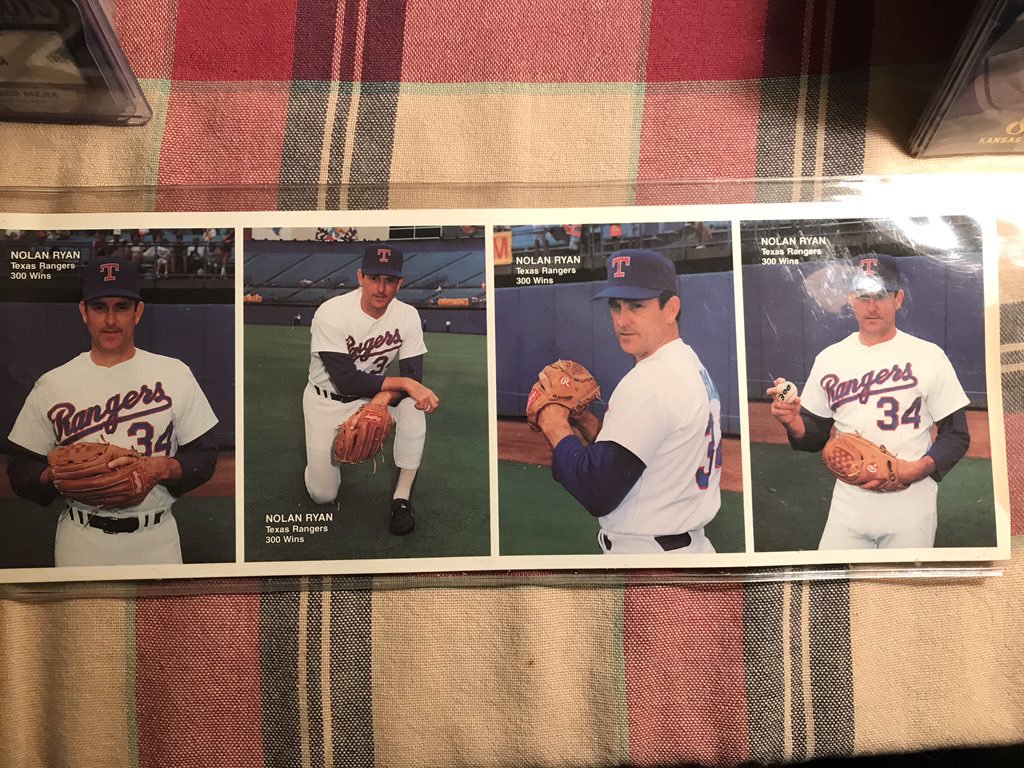


This discussion led me to a quick eBay search to see what I could find out there. Lo and behold, it appears that nearly every single-player set was available in an uncut form, even as early as the 1987 and 1988 Mark McGwire Sets:


When found in the wild in retail, the cards were issued in an interesting manner. Like most food issues, the cards were included in the packages of the cookies for which they were used as a promotional item (credit for this photo goes to The Junior Junkie on Twitter):


For the team sets, the cards combined the best parts of a stadium giveaway with the promotional aspects: while complete sets included 27 or 28 cards, kids going to games in the various cities in the 1980s would receive packets with just twenty of the cards in them. As Giants collector and SABR member Nick Vossbrink noted on the SABR Baseball Cards blog, the packet from the stadium giveaway included a redemption coupon for eight more cards. But, there was no guarantee you would receive the eight cards you needed.

Baseball Cards Magazine noted in October 1984 that these cards would be given away in this manner in varying quantities depending on the city in which the game was located. So, in San Francisco and in Oakland, 20 cards were given to the first 30,000 through the gates. In San Diego, the first 25,000 received their 20 cards, and in Seattle, only the first 20,000 received cards.

Starting in 1987, Mother's started issuing cards of individual players, as the cookie package above for Ken Griffey notes. Going back to the SABR blog, Nick noted that distribution until the early 1990s would include only area-specific cards. So, if you lived in the Bay Area, you were guaranteed either a card of either a Giant or an Athletic. But starting around that early 1990s timeframe, any of the sets that Mother's issued might show up anywhere that the cookies were found.

Also changing in the early 1990s were the stadium giveaways. Turning once again to the SABR blog, Nick mentions that the giveaway started to include 20 cards plus eight copies of some card -- like his 8 Alex Diaz cards. That led to kids running through the stadium trying to find someone to trade with to complete sets. Now that is a great idea to resurrect.

Nick was kind enough to send me a scan of the envelope that held the cards in the early 1990s. As you can see, it describes the fact that each envelope contained 7 of the same card and that everyone needed to help one another to complete a set.


HALL OF FAMERS:

Lots of sets here, so let's go!
1952: Joe Gordon & Mel Ott

1953: None.

1983: Frank Robinson

1984: Nolan Ryan (Astros), Rickey Henderson (A's), Joe Morgan (A's), Billy Williams (A's), Dick Williams (Padres), Rich Gossage (Padres), Tony Gwynn (Padres), Willie Mays (Giants), Willie McCovey (Giants), Juan Marichal (Giants), Gaylord Perry (Giants), Orlando Cepeda (Giants)

1985: Ryan (Astros), Don Sutton (A's), B. Williams (A's), D. Williams (Padres), Gwynn (Padres), Gossage (Padres)

1986: Morgan (Astros), Ryan (Astros), D. Williams (Mariners)

1987: Ryan (Astros), Yogi Berra (Astros), Lasorda (Dodgers), Reggie Jackson (A's; single card and shared card with Canseco), Catfish Hunter (A's), Rollie Fingers (A's), D. Williams (A's), R. Henderson (A's), D. Williams (Mariners)

1988: Ryan (Astros), Berra (Astros), Tommy Lasorda (Dodgers), Sutton (Dodgers), Tony LaRussa (A's), Dennis Eckersley (A's), D. Williams (Mariners)

1989: Craig Biggio (Astros), Berra (Astros), Ken Griffey Jr. (solo 4-card set & Mariners), Lasorda (Dodgers), Eddie Murray (Dodgers), LaRussa (A's), Eckersley (A's), Gossage (Giants), Ryan (Rangers)

1990: Biggio (Astros), Lasorda (Dodgers), Murray (Dodgers), Ryan (solo 4-card set & Rangers), LaRussa (A's), R. Henderson (A's), Eckersley (A's), Gary Carter (Giants), Griffey (Mariners), Randy Johnson (Mariners)

1991: Griffey (4-card set with his dad & Mariners). Biggio (Astros), Jeff Bagwell (Astros), Lasorda (Dodgers), Murray (Dodgers), Carter (Dodgers), Ryan (4-card solo set & Rangers), LaRussa (A's), R. Henderson (A's), Eckersley (A's), R. Jackson (A's), Gossage (Rangers)

1992: LaRussa (A's), R. Henderson (A's), Eckersley (A's), Gossage (A's), Gwynn (Padres), Griffey (Mariners), R. Johnson (Mariners), Ryan (Rangers & 8-card solo set), Ivan Rodriguez (Rangers), Biggio (Astros), Bagwell (Astros & 4-card solo set), Lasorda (Dodgers)

1993: Rod Carew (Angels), Biggio (Astros), Bagwell (Astros), Lasorda (Dodgers), Mike Piazza (Dodgers), Pedro Martinez (Dodgers), Ryan (10-card solo set), LaRussa (A's), Eckersley (A's), R. Henderson (A's), Gossage (A's), Gwynn (Padres), Griffey (Mariners), R. Johnson (Mariners)

1994: LaRussa (A's), Eckersley (A's), R. Henderson (A's), Gwynn (Padres), Trevor Hoffman (Padres), R. Johnson (Mariners), Griffey (Mariners), Gossage (Mariners), Carew (Angels), Bagwell (Astros), Biggio (Astros), Lasorda (Dodgers), Piazza (Dodgers & 4-card solo set & 4-card set with Tim Salmon).

1995: Carew (Angels), Bagwell (Astros), Biggio (Astros), Lasorda (Dodgers), Piazza (Dodgers), LaRussa (A's), Eckersley (A's), R. Henderson (A's), Gwynn (Padres), Hoffman (Padres), R. Johnson (Mariners), Griffey (Mariners)

1996: Carew (Angels), Bagwell (Astros), Biggio (Astros), Lasorda (Dodgers), Piazza (Dodgers), Gwynn (Padres), R. Henderson (Padres), Hoffman (Padres), R. Johnson (Mariners), Griffey (Mariners), I. Rodriguez (Rangers)

1997: Murray (Angels), Carew (Angels), Bagwell (Astros), Biggio (Astros), Piazza (Dodgers), Gwynn (Padres), R. Henderson (Padres), Hoffman (Padres), I. Rodriguez (Rangers)

1998: Bagwell (Astros), Biggio (Astros), R. Johnson (Astros), R. Henderson (A's), Gwynn (Padres), Hoffman (Padres)

ERRORS & VARIATIONS:

For putting out cards for so long, Mother's Cookies did a really good job of avoiding errors. Across all those sets, there are only four errors listed on the Trading Card Database, and all went uncorrected.

1952: Misspelled Marino Pieretti's last name.
1984: Bob Schmidt's card actually features a photo of Wes Westrum
1991: Misspelled Jim Deshaies' last name.
1996: In stating how Rick Wilkins was acquired by the Astros, the card notes he was traded for Scott Service. Wilkins was actually traded for current Mariners manager Scott Servais.

All in all, pretty solid work.

MY TAKE

When these cards were first issued in my lifetime in 1983, they seemed as foreign as something issued in Japan to me. These cards are not rare by any stretch of the imagination, but they were not cards that showed up with any regularity in Milwaukee in the 1980s or in Atlanta in the 2010s.

I don't have any better take or more insight to add than Nick provides on his blog and on the SABR blog. I highly encourage you to read Nick's personal blog post (linked here) in addition to his post on SABR that I linked above. Both provide a ton of information about this set.

As for finding these on eBay, they are out there. With so many years available, if you like these cards, you can find them for sale there.

Monday, January 29, 2018

1981-1986 All-Star Game Program Inserts

INTRODUCTION TO THE SET

Major league baseball was probably the first sports league to hold an All-Star Game. That first All-Star Game was not in 1933, however, but rather it was held on July 24, 1911 when a team of American League all-stars took on the Cleveland Naps in a game put together to benefit the widow of future Hall of Famer Addie Joss.

Joss had died from tubercular meningitis on April 14 after falling ill and fainting prior to a scheduled exhibition game against the Chattanooga Lookouts. Joss was a very popular player around the league, with the Baseball Almanac linked above quoting Walter Johnson as saying, "I'll do anything they want for Addie Joss' family." The All-Stars included Tris Speaker, Ty Cobb, Sam Crawford, Home Run Baker, Hal Chase, Walter Johnson, and Clyde Milan, among others.

Perhaps thinking that the fans deserved something a little extra in their $3 program in Cleveland for the 1981 All-Star Game, someone made the decision to add small cutouts -- 180 in total -- of all the players for whom the fans could vote. The foldouts were repeated in the programs through 1986.

EXEMPLARS

All of these photos were downloaded from eBay auctions. Finding intact programs with the inserts is not difficult, though not every program for sale shows the inserts. And, I could not find a 1983 version quickly that showed the photos, so you're stuck seeing the backs there.

1981


1982

1983

1984

1985

1986

DETAILS

Each program contained fold-out pages containing the 180 players whose names appeared on the All-Star Ballot -- and representative pitchers -- during the years 1981 through 1985, and 260 in 1986. When separated, each "card" is about 1.25" x 2", assuming that the photo was cut out while leaving a thin white border.

Obviously, to get these cards first hand, you had to purchase the program. I have memories of seeing ads during certain games where one could send money to a P.O. Box and receive a copy of the program in return. I will admit that I don't know if the ad shows up in this televised version of 1982 All-Star Game -- a very good quality version from Montreal's Olympic Stadium with a very young Al Michaels on the call. 


I had to link to this wonderful version of the game, which is worth watching almost as much for the Montreal montage at the beginning as anything, but almost more for the brief interview of Rachel Robinson, Jackie's widow. Also fun -- this game actually has all the advertisements included. There's nothing like watching 36-year-old Wendy's ads.

Another aside from that 1982 game: I'd completely forgotten about the fact that Robin Yount almost did not make the All-Star Game thanks to the fact that those damn Yankees fans thought Bucky Dent should be in the lineup ahead of him. Finally, I appreciate the fact that the Montreal fans booed Reggie Jackson.

Anyway, there is nothing I could find easily that provided information regarding how many programs were printed each year such that we could figure out how many of these inserts were printed.

Interestingly, these sets are not included in the Standard Catalog, though PSA includes them in the Player Collection sets in their registry.

HALL OF FAMERS

Considering that these inserts represent the starting lineups and the top pitchers from each team, the number of Hall of Famers is pretty high.

1981 (28)
Rod Carew, Tony Perez, Eddie Murray, Alan Trammell, Robin Yount, George Brett, Carlton Fisk, Rickey Henderson, Reggie Jackson, Paul Molitor, Jim Rice, Dave Winfield, Carl Yastrzemski, Rollie Fingers, Rich Gossage, Willie Stargell, Ozzie Smith, Mike Schmidt, Johnny Bench, Gary Carter, Andre Dawson, Steve Carlton, Nolan Ryan, Tom Seaver, Ted Simmons, Bruce Sutter, Don Sutton

1982 (27)
Harold Baines, Bench, Brett, Carew, Carlton, Carter, Dawson, Fingers, Fisk, Henderson, Jackson, Molitor, Joe Morgan, Jack Morris, Murray, Tim Raines, Rice, Cal Ripken Jr., Schmidt, Simmons, Smith, Sutter, Sutton, Trammell, Winfield, Yastrzemski, Yount

1983 (30)
Carew, Murray, Yaz, Ripken, Trammell, Yount, Wade Boggs, Brett, Molitor, Fisk, Simmons, Baines, Henderson, Jackson, Rice, Winfield, Bert Blyleven, Dennis Eckersley, Morgan, Ryne Sandberg, Smith, Schmidt, Carter, Dawson, Raines, Carlton, Fergie Jenkins, Ryan, Seaver, Sutter

1984 (27)
Baines, Blyleven, Boggs, Brett, Carew, Carter, Dawson, Fisk, Gossage, Gwynn, Henderson, Jackson, Molitor, Jack Morris, Murray, Raines, Rice, Ripken, Ryan, Sandberg, Schmidt, Simmons, Lee Smith, Ozzie Smith, Trammell, Winfield, Yount

1985 (28)
Carew, Murray, Ripken, Trammell, Yount, Boggs, Brett, Molitor, Fisk, Henderson, Jackson, Kirby Puckett, Rice, Winfield, Morris, Seaver, Sandberg, Smith, Schmidt, Carter, Dawson, Gwynn, Raines, Eckersley, Gossager, Ryan, Baines, Morris

1986 (25)
Blyleven, Boggs, Brett, Carlton, Carter, Dawson, Fisk, Gossage, Gwynn, Henderson, Jackson, Molitor, Murray, Puckett, Raines, Rice, Ripken, Sandberg, Schmidt, Seaver, Smith, Sutter, Trammell, Winfield, Yount

ERRORS/VARIATIONS

The only error in any of the sets actually comes in 1982, and it affects a recently named Hall of Famer. Rather than picturing Jack Morris, the photo is actually of Kevin Saucier. It's an easy mistake to make -- you know, all those white guys with mustaches all look alike, even if Morris threw right-handed and Saucier threw left-handed.

MY TAKE

I never had any of these when I was a kid, and I really did not know anything about them at the time. If I had, perhaps I would have come up with the $5 or so to get one of these programs. 

Of course, these were the good old days when voting for all-stars involved real ballots and potentially ballot-box stuffing.  That ballot-box stuffing was a legitimate enterprise -- when fans would talk their friendly ushers into giving them dozens of the punch-card ballots. Once obtained, poking out the chads of the players you voted for was like a kids version of the 2000 election in Palm Beach County -- you had better be sure you didn't leave any hanging chads! You'd end up with a ton of little rectangles of cardboard covering yourself. 

I can only speculate how these got to be listed on the Trading Card Database as "oddballs." It's probably the result of their inclusion in the registry sets for players with Beckett. After all, you have to have some more difficult to find items to make things interesting, right?

As I mentioned above, finding programs with these in them is not difficult. The programs will vary in cost, so shop around.
It's also not difficult to find these little slips of glossy paper for sale in team sets either on eBay or elsewhere. 

So, what do you guys and gals think -- are these "baseball cards" or are they just photos cut out of a magazine? Do you include them in your collections?

Edit: Since I wrote this post, it appears that the Trading Card Database and Beckett's stopped including the 1986 set in their listings -- perhaps because they have the photos on both sides as some of you noted.

Tuesday, July 4, 2017

1983-1987 Donruss Action All-Stars

INTRODUCTION TO THE SET
The Donruss Company started out in Memphis in 1954 as the creation of two brothers named . . . wait for it . . . Donald and Russell Weiner. Their father, Thomas, had made his money mainly in candy production, and his company was very successful in the 1940s and 1950s with its Super Bubble gum brand. The brothers took charge of dad's company in 1954 and gave it the portmanteau name of Donruss. Don took over as the sole shareholder by the early 1960s.

During the 1960s, they issued non-sports cards for a variety of TV shows including the Monkees. The candy side of the company did well enough to convince General Mills to purchase the company in 1969. 


In the 1970s, Donruss continued issuing TV show cards and also branched into music with sets for Elvis Presley and Kiss. This production of cards led Donruss to be well positioned to enter the baseball card market in 1981, after Fleer successfully challenged Topps's monopoly in court.

For oddball purposes, it apparently took a couple of years for Donruss to feel secure enough in its licensing to take the plunge. That, or perhaps it was the fact that in 1983, Huhtamäki Oyj (a Finnish company) had purchased Donruss, Beatrice US Confections, and the Leaf Candy Company and merged them together into the single entity of Leaf, Inc. (at the time, the maker of Jolly Rancher candies). This would make sense, because Donruss had a big problem in its first two years in distribution.


Thus, the Donruss Action All-Stars set was born and in all likelihood was merely an attempt at leveraging and using the licenses that Donruss had obtained from the MLBPA and MLB.

EXEMPLARS
The Donruss Action All-Stars sets were issued in 1983, 1984, and 1985. The name changed to just "All-Stars" in 1986, but the cards retained their large size. When I posted this first, I had not included 1986 or 1987 due to the name change, but the size of those cards puts them into this set.

1983


1984


1985


1986


1987


DETAILS
Each of the sets includes 60 cards and measure 3.5" x 5". As you can see, Donruss never really settled on a particular presentation format to use as its design until it changed its name to "All-Stars". While there is nothing wrong with that approach, the design over the first three years seemed to be trying to find something that worked. In other words, it's the making of an oddball. 

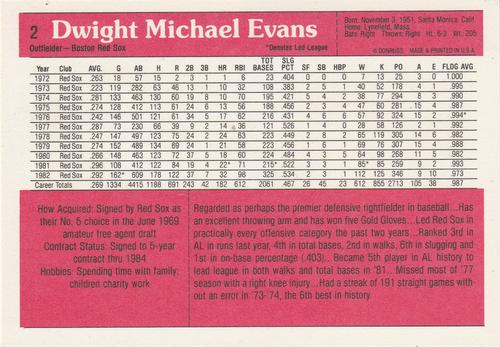
In 1983, the cards sort of remind me of the 1960 Topps set with an action photo and a portrait -- but it's not an exact match. The gray background on the 1983 cards features the player's team name repeated as a sort of boring wallpaper. The backs of the cards are all red and white with black writing providing a full accumulation of career stats, birthdates and locations, acquisition background, contract status, and career highlights. In its packs, the 1983 set also included 3 pieces of the 63-piece Mickey Mantle puzzle which Baseball Card Pedia calls "one of the toughest Donruss puzzles of the era." This Mantle puzzle was exclusive to the Action All-Stars, as the flagship included a Ty Cobb puzzle.

In 1984, Donruss tried something completely different and was very successful, in my opinion. The fronts of the cards all feature action shots and the backs provide the portrait photo. To my memory, this might be the first time that the backs of a card product featured a full-color photograph. Of course, Donruss brought back that boring wallpaper of team-name-on-gray for use as the portrait background. But, the action photos were excellent and made use of larger card size well. The backs also include all the vital statistics contained on the first card backs but in a smaller and less legible print. As for the puzzle piece, the Ted Williams puzzle was exclusive to Action All-Stars while the flagship included a Duke Snider puzzle. 

The 1985 set came closer to mimicking the flagship design than did the 1983 or 1984 sets. While Donruss's flagship went with a black border with five red lines of varying width beginning about 3/4 of the way down the front of the card, the Action All-Stars drew from that bastion of design -- graph paper -- and used a checked pattern on a black border. Call it the Max Headroom-ification of baseball card design. The light-blue card backs were easier to read than the previous year's efforts, though moving the portrait back to the front made the backs just a bunch of text. For the puzzle pieces, Donruss went with the same Lou Gehrig puzzle that featured in its flagship.

In 1986, Donruss pretty much gave up on trying to be different with the set. The design tracks almost exactly the flagship design. The back changed to include only the 1985 All-Star game stats along with a career All-Star game total. The backs are outlined in yellow with a white background and the team and All-Star Game logo. The packs included the Hank Aaron puzzle from the flagship. But, for the first time, a second insert was included: a pop-up subset of 18 players (the All-Star starters) was included. Here's an example:


1987 was similar to 1986 -- same name, same types of stats on the back, and same inserts included. Donruss did not include the little ball design that was included on its flagship on the middle part of the card on these, however, so the 1987 All-Stars are a pure black border.

Each of these sets through 1986 were packaged in clear cellophane packages so player collectors can add another item to their collection by finding that package with their guy on the front or back. The 1987 set was packed into wax packs.

HALL OF FAMERS
1983: 
Eddie Murray, Reggie Jackson, Andre Dawson, Phil Niekro, Johnny Bench, Rickey Henderson, Nolan Ryan, Steve Carlton, Gaylord Perry, Rollie Fingers, Dave Winfield, Rod Carew, Bruce Sutter, George Brett, Carlton Fisk, Carl Yastrzemski, Cal Ripken Jr., Robin Yount, Mike Schmidt, Gary Carter

1984: 
Yount, Henderson, Harold Baines, Ryan, Dawson, Ripken, Wade Boggs, Carlton, Paul Molitor, Jackson, Ryne Sandberg, Bert Blyleven, Murray, Jim Rice, Tom Seaver, Brett, Schmidt, Ted Simmons

1985:
Tim Raines, Ripken, Murray, Winfield, Rich Gossage, Schmidt, Tony Gwynn, Ryan, Yount, Sandberg, Brett, Rice, Ozzie Smith, Fingers, Boggs, Jackson, Alan Trammell, Niekro, Carlton, Carter, Baines

1986:
Gwynn, O. Smith, Henderson, Brett, Murray, Ripken, Winfield, Rice, Fisk, Jack Morris, Raines, Ryan, Gossage, Sandberg, Dick Williams, Molitor, Trammell, Boggs, Baines, Blyleven, Sparky Anderson

1987:
Winfield, Kirby Puckett, Ripken, Henderson, Boggs, Sandberg, O. Smith, Gwynn, Schmidt, Carter, Whitey Herzog, Baines, Brett, Murray, Raines, Rice

It's almost surprising how few Hall of Famers were included in these sets when you think about the fact that these are intended to be "All-Stars." When you look at who might have been included, though, you can see that the mid-1980s have a fair number of stars who have not made it into the Hall. I cannot understand how Lou Whitaker is not enshrined, for instance. 

Edit: Since this was posted in 2017, Alan Trammell, Harold Baines, Jack Morris, and Ted Simmons have all been elected to the Hall of Fame. If others get inducted, I'll keep adding them. 

VARIATIONS/ERRORS
For a card issuer that seemed to make a ton of mistakes with its flagship sets, the Action All-Stars are surprisingly lacking in errors and variations.

In 1983, the Reggie Jackson card has a variation where part of his career statistics are covered by the red banner printing that was intended to be behind only the top line information of name, birth date, etc., and the bottom line of contract, acquisition, and career highlights. That mistake was corrected.

1984 does not have any reported errors or variations. Neither does 1985, nor does 1986, nor does 1987.

MY TAKE
I recall the first time I saw any packs of these Action All-Stars. My mom had decided to take us to a five-and-dime store in a nearby "city" to where we lived -- not the closest town, but the closest city of about 10,000 people. I seem to recall that it was a Ben Franklin Store in Hartford, Wisconsin. It was there that I found a lot of the more "exotic" cards that I bought with my nickels and dimes in the early 198os.

In my mind's eye, I can still see -- even sort of smell -- that store. The store focused a lot on crafts, and my mom was really into crocheting at the time. So, we would drive over to Hartford (which was about a 10-mile drive) and she would pick up some skeins of yarn. If I was lucky, I'd get to pick up a pack of Fleer or Donruss cards (because Topps was always available at the local grocery store) or I'd run across one of these oddball issues. I had a bunch of the 1983s, very few of the 1984s, none of the 1985s, some of the 1986s, and I don't recall ever seeing the 1987 cards in stores. 

I have always liked these Action All-Star cards. They work great for autographs -- particularly the 1984 set with its action photos on the fronts -- and Ultra Pro has a sheet that fits these cards in perfectly. These sets started to show Donruss as a true competitor to Topps as well. Even in the early 1980s, a card company could not make enough money, it seems, just by leveraging its license through a flagship product only. 

How available are these today in unopened packages? An unopened box of 38 packs each containing three puzzle pieces and six cards will run you $24.71 for the 1983 offering. So, doing the math, that's 114 puzzle pieces (63 is the complete puzzle) and 228 cards. For 36 packs of three puzzle pieces and five cards in 1984, that same price of $24.71 applies. As for 1985, it was packaged with three puzzles pieces and five cards as well, and there is a box available as of this writing on eBay for $14.85. That means in 1984 or 1985, you'll get 108 puzzle pieces and 180 cards in each box. 

In other words, if you buy an unopened box, you are almost guaranteed at least a complete set of the cards, and you have a good chance to complete the puzzle too. It's a fun rip, and it lets you leave some packs unopened.

The 1986 and 1987 cards appear to be less available. There is one unopened box of 1986 and of 1987 on eBay currently for $19.99 each, and the same seller has a lot including a box each from 1986 and 1987 for $39.99. These boxes include 108 puzzle pieces, 108 All-Star cards, and 36 pop-ups. You still have a decent chance to complete these sets, but the correlation has to be good.