Showing posts with label 1982. Show all posts

Sunday, June 28, 2020

1982 Burger King Atlanta Braves Collector Lids

INTRODUCTION TO THE SET

Burger King as a concept began in 1953 in Jacksonville, Florida. Keith Kramer and his wife's uncle Matthew Burns began the company as "Insta-Burger King," and soon after began franchising the concept. The key equipment for Kramer and Burns was the use of the Insta-Broiler, which became a part of the required package for franchisees. 

One of their franchisee groups was owned by James McLamore and David Edgerton. The two were alumni of Cornell University's renown School of Hotel Administration, and they were looking for a business to open. They'd visited the original McDonald's hamburger stand -- before the MacDonalds were bought out by Ray Kroc -- and thought that it was an idea they could replicate. They obtained a franchise from Kramer and Burns and opened up shop at 3090 NW 36th Street in Miami -- a spot which is now the home of a used car and title pawn lot. 

McLamore and Edgerton were wildly successful and opened multiple locations by the end of the 1950s in and around Miami. But, they ran into problems with the Insta-Broiler -- the beef patty drippings caused the heating elements underneath to rust and degrade, thereby requiring replacement. So, they came up with a solution that moved the patties over the flame on a metal conveyor belt in what they called the "flame broiler." 

Meanwhile, Kramer and Burns had expanded quickly but did not have their own corporate finances in place. By the end of the 1950s, their concept was in trouble. This led them to sell their company and the rights to issue franchises across the country to McLamore and Edgerton. The two renamed the company "Burger King of Miami," which eventually became the Burger King Corporation. The headquarters for Burger King is still in Miami -- located on the other side of Florida Highway 836 from Miami International Airport. 

The company grew to 274 restaurants nationwide by 1967. The problems that the company faced at the time are problems typical to franchises generally: lack of consistency across locations, an inability to maintain brand standards, an inability to be involved in sales of franchises to the next person (potentially leading to undercapitalized franchisees), and franchisees who were not contractually prevented from "going rogue" and adding menu items however they saw fit. Sensing an opportunity, the Pillsbury Company purchased the franchise system from McLamore and Edgerton for an estimated $18 million.

Pillsbury's ownership was wildly successful though bumpy. Pillsbury grasped control over the franchise relationship and imposed multiple new restrictions over new franchisees. Menus were locked down. New items were added -- including my favorite, the Original Chicken Sandwich, which tastes so good because it is comprised of chicken, breading, and salt (it has 1170 mg of salt -- just 78% of your recommended daily allowance of sodium!). Burger King even took on the 800-pound gorilla in the room by making direct attacks on McDonald's and its way of cooking burgers. All of this was under the leadership of Donald N. Smith (a former McDonald's executive) and Norman E. Brinker. 

Once Smith and Brinker left, however, Pillsbury started giving leeway back to the restaurant owners to operate more independently again. Profits stalled. In response to BK's declining valuation, British beverages giant Grand Metropolitan PLC (which later merged with Guinness to form Diageo in 1997) first tried to take over the company in a hostile takeover and, then, acquired it through an agreed sale in 1988 for $5.7 billion. Grand Metropolitan expanded worldwide and tapped into new markets like airports, on-campus university locations, and sports arenas. 

Once Diageo formed, however, BK seemingly got ignored by its corporate owners. Recognizing that alcohol was a more lucrative business for the company and was its core business, Diageo spun BK off and sold it to TPG Capital for $1.5 billion in 2002.  TPG modernized operations, changed up the trade dress to update it to a more modern look, and required remodeling or replacement of nearly all of BK's locations in North America to meet "brand standards." Beer was added to the menu in some US locations as well for the first time. TPG floated BK on the New York Stock Exchange as well. 

By 2010, TPG was looking for an exit strategy. In September 2010, TPG sold its 31% stake in the company to 3G Capital for $3.26 billion -- a massive return on TPG's investment over and above the money it made when BK went public. 3G pushed to expand BK locations in Brazil, Russia, India, and China, planning for more than 2500 new locations. Another addition to the BK offerings came in August 2014, when 3G purchased Canadian giant Tim Hortons. 

EXEMPLARS


DETAILS

In 1982, no team in America was hotter than the Atlanta Braves. Managed by future HOF manager and former Brave Joe Torre, the team started off the year with a record-setting 13-game winning streak behind the pitching of Rick Mahler, Larry McWilliams, Gene Garber, and Rick Camp and the hitting of eventual 1982 MVP Dale Murphy. 

To commemorate the streak, Burger King teamed with the MLBPA for what appears to be a fully licensed set of 27 lids to accompany sodas -- or, as they would have been called in the local Atlanta-area Burger Kings, cokes (which is a generic term for any fizzy drink in Georgia, basically). As Beckett notes, these lids were intended for use with large cokes and specifically for a special collector's cup listing out the scores for the 13-game season-opening win streak. 

It appears that the lids simply used the photos that the Braves had on hand for each player for publicity shots. All the photos feature the players' heads poking out of their V-neck polyester Braves uniform. Next to the photo are basic stats from the strike-shortened 1981 season and the players' heights and weights. 

Apparently, the lids were distributed to local Burger King stores as complete sets. At least that is what this auction seems to imply by saying by selling the lids in the auction as a complete set "still wrapped in originals [sic] cellophane, torn on top." Does this mean that you got the complete set of lids just by purchasing a single large drink? That would seem to be unlikely and that, instead, the lids were provided to franchisees in sets and whatever lid happened to be on top is what you got.

As you can imagine, finding these lids in top shape is a challenge. This is, after all, a drink lid that was intended to be penetrated by a straw in a pre-perforated hole. Add in the fact that the lid is made of wax-covered paper inside a plastic ring, and you have a recipe for an item that would be very difficult to find intact.

HALL OF FAMERS

Just one in Phil Niekro

Of the remaining players, Dale Murphy gets a lot of love from Braves fans in particular and fans of 1980s baseball generally. He never got above 23.2% or below 8.5% of the vote from the BBWAA during his 15 years on the HOF ballot despite the fact that his numbers match up relatively well on all of Bill James's HOF standards other than the "HOF Standards" board. Murphy's problem is one of a career without the "hanging on" stats. His WAR for his 7-year peak is 41.2 -- not far off the average CF's 7-year peak of 44.7. But, outside of his peak, Murphy's career war is just 46.5. Basically, Murphy's career was all peak and no filling. 

Perhaps if Murphy got to play the entire 1981 season to allow him to get over the 400-homer mark for his career (finished at 398), it might have made the difference. Or, if he didn't come up for election in the midst of the fully steroid inflated late 1990s, his numbers would have seemed more acceptable to voters. 

Still, if Murphy were inducted tomorrow, he'd be a better HOF member on his resume than a number of guys in now, including his contemporary Harold Baines, whose main recommendation over Murphy appears to be longevity (in the midst of the steroid era) over peak. 

ERRORS/VARIATIONS

None.

MY TAKE

My father-in-law has worked for and/or owned Burger King franchises for his entire working life -- since he was 14 years old, in fact. My greatest disappointment in him is the fact that he did not keep any of these lids or any other baseball-themed items from Burger King. 

Since I lived in Wisconsin at the time, I never heard of these lids until much later in my life. If I had lived in Atlanta at the time, well, I almost certainly would have been a Braves fan who really wanted these lids. 

As a Brewers fan in 1982, though, I was 100% rooting for the Braves to make it to the World Series. Many Milwaukeeans were. We wanted the "rematch" for the city of Milwaukee. Keep in mind, too, that the 1982 season was the 25th anniversary of the one and only World Series championship that the Milwaukee Braves had earned. The symmetry of Brewers versus Braves in the World Series for the 25th anniversary would have been excellent.

I was surprised to note that there were fairly significant parallels between the 1982 Braves and the 1987 Milwaukee Brewers. Both were very streaky teams that started out the season with 13-game winning streaks only to suffer double-digit losing streaks later in the year. 

The Brewers started out the 1987 season with a 20-3 record through May 2. Then, on May 3, the team started a twelve-game losing streak to go from 20-3 to 20-15 -- thereby becoming the first team in major league history to have winning and losing streaks exceeding twelve games each. 

The reason that the record had to be "exceeding twelve games each" is that the 1982 Braves weren't far off that. The Braves won 13 games to start the season -- culminating in a walkoff win against Cincinnati and Bob Shirley on April 21. Unlike the Brewers, though, the Braves waited until August to go on their epic losing streak. From August 3 through August 13, the Braves lost 11 straight games, including four games lost in walk-off fashion in extra innings (including 3 straight to the Dodgers on August 5-7). The Braves went from being 7 games ahead of the pack on August 2 to being 2.5 games out of first by August 13.

In terms of getting these lids, there seem to be a few lids floating around on eBay, with three complete sets ranging in price from $63 to $100. Those prices seem a bit exorbitant, but, as I said, these have to be pretty tough to find in good shape.

Sunday, May 26, 2019

1981-1982 Topps Squirt

INTRODUCTION TO THE SET

Squirt brand soda came about in an effort to skimp on ingredient costs during the Great Depression. In the official "biography" for the soda taken from the Dr. Pepper legacy site before its merger with Keurig, the story is told about how, in 1938, a man named Herb Bishop started experimenting with a now-gone (as best I can tell) brand called "Citrus Club." 

Citrus Club was apparently popular in Phoenix. But, it being 1938 -- which saw a recession return in the midst of the recovery from the depths of the Depression -- people were trying to figure out ways to save money in manufacturing products. Bishop decided to reduce the amount of fruit juice and sugar in the product and increase the amount of soda water. This lead to a lighter, less sweet drink flavored with grapefruit. Bishop chose the name "Squirt" for this new drink.

In the 1940s, Bishop and business partner Ed Mehren created successful marketing campaigns around a cartoon character called "Little Squirt." By the 1950s and 1960s, Squirt became a popular drink mixer in bars. It also attracted imitators like Fresca, which debuted in 1966.

Imitation meant competition, and, to ensure that Squirt remained a viable product, competition led to consolidation in the 1970s. In 1977, regional bottler Brooks Products of Holland, Michigan, purchased the brand. Brooks later became known as Beverage America. Brooks started in 1936 in Michigan and started out with selling 7-UP bottled in beer bottles. Brooks's addition of Squirt was a major change -- putting Brooks in direct competition with Pepsi and Coke.

Under Brooks's ownership, Diet Squirt was created in the early 1980s as the first soft drink brand to use NutraSweet after the U.S. Food and Drug Administration banned the use of the cheaper Cyclamate due to cancer concerns. 

This innovation led also to exploring different ways to get kids to buy their products -- like using baseball cards from Topps in the same way that its competitors Pepsi and Coca Cola had done in the 1970s with both licensed and unlicensed discs and cards.

In the 1990s, consolidation was again the name of the game. Select Beverages -- which was another independent soft drink bottler and distributor from the Chicago suburb of Darien -- and Beverage America were swallowed up in 1998 by Cadbury Schweppes PLC out of the UK. The transaction was funded by noted private investment company The Carlyle Group, which retained 60% ownership to Cadbury's 40% ownership. Then, in 2000, Cadbury Schweppes purchased RC Cola, Snapple, Mistic, and Stewart's from Triarc Companies. Finally, in 2006 and 2007, Cadbury snapped up its distribution chain by purchasing Dr Pepper/Seven Up Bottling Group.

That led to a spin off from Cadbury Schweppes as Dr Pepper Snapple Group. That company traded publicly on the New York Stock Exchange as DPS, while the rest of Cadbury remained a chocolate confectioner. 

Finally, on July 9, 2018, Keurig Green Mountain purchased Dr Pepper Snapple Group and merged the parts together. That new company -- which still owns Squirt -- is Keurig Dr Pepper and is based in Plano, Texas -- a Dallas suburb.

EXEMPLARS
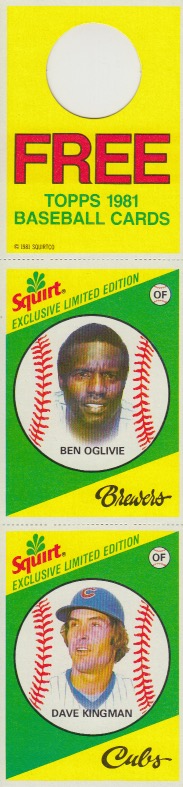
1981 Detached

Complete Panels


1982 Detached
1982 Single Card Panel

1982 Double Card Panel

Single Card Panel with Scratch-Off Game


DETAILS

Topps and Squirt teamed up on cards both in 1981 and 1982. In 1981, the set was comprised of 33 cards, while in 1982 it was scaled back to 22. 

I'm sure that making a set of 33 cards initially made sense to the folks at Topps. At the time, their card sets were printed on sheets of 132, so that would mean four sets per printed sheet, right? 

Someone forgot to figure out, however, that these cards would be issued two per panel draped on soda bottles in 6-packs. The math is not as neat when one tries to distribute an odd number of cards in sets of two. This led to a mishmash of double prints -- the first 11 cards in the set (including card three, Ben Oglivie, shown above) were all double printed. As a result, to obtain a true complete set of panels, one must purchase a total of twenty-two panels to get all thirty-three cards.

Oddly, according to Trading Card Database, four cards are short printed -- card 15 Eddie Murray, #26 Ron LeFlore, #27 Steve Kemp, and #28 Rickey Henderson. According to the Standard Catalog of Baseball Cards (2011 edition), both Murray and LeFlore shared panels with Steve Garvey (who is still listed as double printed), while Kemp shared a panel with Reggie Jackson and Henderson shared with Bill Buckner. I'm not sure how these short prints really work in this set.

Design-wise for 1981, the photos of the players are small and inside a baseball on the ball's sweet spot. The front design echoes the team name font used on 1978 Topps (which also used the "position in a baseball" design feature used in both sets). The backs, of course, use exactly the same color scheme and text of the 1981 base set.

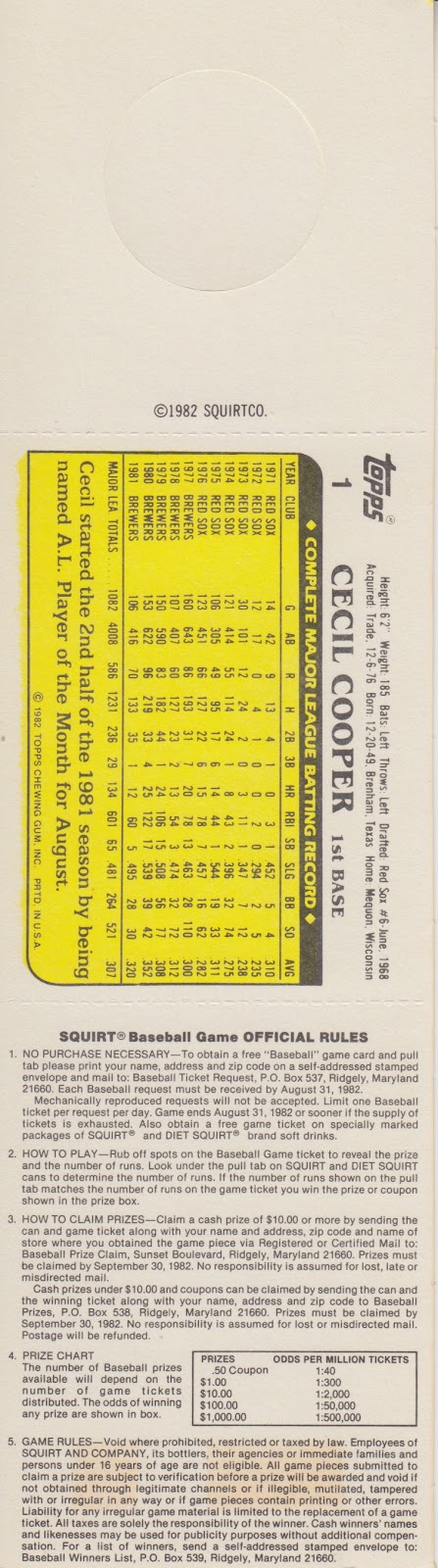
Where 1981's distribution weirdness came from issuing 33 cards in sets of two, 1982's three different ways of obtaining the cards stems from the contest that Squirt ran in conjunction with the cards. According to the 2011 Standard Catalog, "[c]ard panels come in four variations, with free grocery contest and scratch-off game cards taking one or two of the positions on the three-card panels." So, cards can be found either fully detached, on a single-card panel with a free grocery contest panel (which includes the perforations for the card to be jammed over the bottleneck) and a scratch-off game panel, or with two cards and either the contest panel or the scratch-off panel, I suppose. I don't have this set in complete form, so I'm not fully clear about how it works. 

The backs on the 1982 cards are the same design as the 1982 Topps base set. However, the set is printed on white card stock, leading to a yellow, black, and white card back that quite frankly is much easier to read and more attractive than the set on which the back is based.

Finally, Topps cribbed at least a few photos from other Topps sets for its Squirt set. For example, the Cecil Cooper photo on card #1 in 1982 is the same photo that Topps used on his 1980 Topps base set card. There are a few others that look close, but that one jumped out at me thanks to my knowing Cooper's cards so well.

HALL OF FAMERS

Despite this ostensibly being an All-Star type set, less than half of the 1981 set are HOFers.

1981: George Brett, Reggie Jackson, Jim Rice, Mike Schmidt, Rod Carew, Eddie Murray, Don Sutton, Dave Winfield, Johnny Bench, Rickey Henderson

1982 improved on 1981 -- exactly half are HOFers.

1982: Brett, Alan Trammell, Jackson, Winfield, Carlton Fisk, Rollie Fingers, Schmidt, Andre Dawson, Gary Carter, Tom Seaver, Bruce Sutter

ERRORS/VARIATIONS

There are no errors listed for either set on Trading Card Database for this set. The Variations are essentially self-made as described above -- is the card perforated? Is it on a panel? Is it a 1981 with different panel mates for the first 11 cards? Is it a 1982 with the three/four types of panels available?

MY TAKE

I don't ever recall seeing these in my local grocery stores in Wisconsin. I probably would have snatched them up, tried the soda, hated it, and tried to figure out a way to get the cards without having to drink the soda. One of the few things in life that I do not like to eat are grapefruits. 

For being regional sets issued 37 and 38 years ago, these cards appear to be fairly available on eBay. I got a complete set of the 1981 panels and all of its variations for under $10 about two years ago. There are multiple lots available for purchase for the 1981 set, and there are even more individual sets and lots available for 1982. In fact, I just bought a 1982 set of the individual panels for $5 thanks to an eBay coupon that saved me $4 (basically paid for shipping). 

If you don't have these sets already, do some scanning through the eBay auctions to find good deals. Be patient -- you shouldn't have to pay a bunch to pick up either of these sets in perfect condition.

Monday, January 29, 2018

1981-1986 All-Star Game Program Inserts

INTRODUCTION TO THE SET

Major league baseball was probably the first sports league to hold an All-Star Game. That first All-Star Game was not in 1933, however, but rather it was held on July 24, 1911 when a team of American League all-stars took on the Cleveland Naps in a game put together to benefit the widow of future Hall of Famer Addie Joss.

Joss had died from tubercular meningitis on April 14 after falling ill and fainting prior to a scheduled exhibition game against the Chattanooga Lookouts. Joss was a very popular player around the league, with the Baseball Almanac linked above quoting Walter Johnson as saying, "I'll do anything they want for Addie Joss' family." The All-Stars included Tris Speaker, Ty Cobb, Sam Crawford, Home Run Baker, Hal Chase, Walter Johnson, and Clyde Milan, among others.

Perhaps thinking that the fans deserved something a little extra in their $3 program in Cleveland for the 1981 All-Star Game, someone made the decision to add small cutouts -- 180 in total -- of all the players for whom the fans could vote. The foldouts were repeated in the programs through 1986.

EXEMPLARS

All of these photos were downloaded from eBay auctions. Finding intact programs with the inserts is not difficult, though not every program for sale shows the inserts. And, I could not find a 1983 version quickly that showed the photos, so you're stuck seeing the backs there.

1981


1982

1983

1984

1985

1986

DETAILS

Each program contained fold-out pages containing the 180 players whose names appeared on the All-Star Ballot -- and representative pitchers -- during the years 1981 through 1985, and 260 in 1986. When separated, each "card" is about 1.25" x 2", assuming that the photo was cut out while leaving a thin white border.

Obviously, to get these cards first hand, you had to purchase the program. I have memories of seeing ads during certain games where one could send money to a P.O. Box and receive a copy of the program in return. I will admit that I don't know if the ad shows up in this televised version of 1982 All-Star Game -- a very good quality version from Montreal's Olympic Stadium with a very young Al Michaels on the call. 


I had to link to this wonderful version of the game, which is worth watching almost as much for the Montreal montage at the beginning as anything, but almost more for the brief interview of Rachel Robinson, Jackie's widow. Also fun -- this game actually has all the advertisements included. There's nothing like watching 36-year-old Wendy's ads.

Another aside from that 1982 game: I'd completely forgotten about the fact that Robin Yount almost did not make the All-Star Game thanks to the fact that those damn Yankees fans thought Bucky Dent should be in the lineup ahead of him. Finally, I appreciate the fact that the Montreal fans booed Reggie Jackson.

Anyway, there is nothing I could find easily that provided information regarding how many programs were printed each year such that we could figure out how many of these inserts were printed.

Interestingly, these sets are not included in the Standard Catalog, though PSA includes them in the Player Collection sets in their registry.

HALL OF FAMERS

Considering that these inserts represent the starting lineups and the top pitchers from each team, the number of Hall of Famers is pretty high.

1981 (28)
Rod Carew, Tony Perez, Eddie Murray, Alan Trammell, Robin Yount, George Brett, Carlton Fisk, Rickey Henderson, Reggie Jackson, Paul Molitor, Jim Rice, Dave Winfield, Carl Yastrzemski, Rollie Fingers, Rich Gossage, Willie Stargell, Ozzie Smith, Mike Schmidt, Johnny Bench, Gary Carter, Andre Dawson, Steve Carlton, Nolan Ryan, Tom Seaver, Ted Simmons, Bruce Sutter, Don Sutton

1982 (27)
Harold Baines, Bench, Brett, Carew, Carlton, Carter, Dawson, Fingers, Fisk, Henderson, Jackson, Molitor, Joe Morgan, Jack Morris, Murray, Tim Raines, Rice, Cal Ripken Jr., Schmidt, Simmons, Smith, Sutter, Sutton, Trammell, Winfield, Yastrzemski, Yount

1983 (30)
Carew, Murray, Yaz, Ripken, Trammell, Yount, Wade Boggs, Brett, Molitor, Fisk, Simmons, Baines, Henderson, Jackson, Rice, Winfield, Bert Blyleven, Dennis Eckersley, Morgan, Ryne Sandberg, Smith, Schmidt, Carter, Dawson, Raines, Carlton, Fergie Jenkins, Ryan, Seaver, Sutter

1984 (27)
Baines, Blyleven, Boggs, Brett, Carew, Carter, Dawson, Fisk, Gossage, Gwynn, Henderson, Jackson, Molitor, Jack Morris, Murray, Raines, Rice, Ripken, Ryan, Sandberg, Schmidt, Simmons, Lee Smith, Ozzie Smith, Trammell, Winfield, Yount

1985 (28)
Carew, Murray, Ripken, Trammell, Yount, Boggs, Brett, Molitor, Fisk, Henderson, Jackson, Kirby Puckett, Rice, Winfield, Morris, Seaver, Sandberg, Smith, Schmidt, Carter, Dawson, Gwynn, Raines, Eckersley, Gossager, Ryan, Baines, Morris

1986 (25)
Blyleven, Boggs, Brett, Carlton, Carter, Dawson, Fisk, Gossage, Gwynn, Henderson, Jackson, Molitor, Murray, Puckett, Raines, Rice, Ripken, Sandberg, Schmidt, Seaver, Smith, Sutter, Trammell, Winfield, Yount

ERRORS/VARIATIONS

The only error in any of the sets actually comes in 1982, and it affects a recently named Hall of Famer. Rather than picturing Jack Morris, the photo is actually of Kevin Saucier. It's an easy mistake to make -- you know, all those white guys with mustaches all look alike, even if Morris threw right-handed and Saucier threw left-handed.

MY TAKE

I never had any of these when I was a kid, and I really did not know anything about them at the time. If I had, perhaps I would have come up with the $5 or so to get one of these programs. 

Of course, these were the good old days when voting for all-stars involved real ballots and potentially ballot-box stuffing.  That ballot-box stuffing was a legitimate enterprise -- when fans would talk their friendly ushers into giving them dozens of the punch-card ballots. Once obtained, poking out the chads of the players you voted for was like a kids version of the 2000 election in Palm Beach County -- you had better be sure you didn't leave any hanging chads! You'd end up with a ton of little rectangles of cardboard covering yourself. 

I can only speculate how these got to be listed on the Trading Card Database as "oddballs." It's probably the result of their inclusion in the registry sets for players with Beckett. After all, you have to have some more difficult to find items to make things interesting, right?

As I mentioned above, finding programs with these in them is not difficult. The programs will vary in cost, so shop around.
It's also not difficult to find these little slips of glossy paper for sale in team sets either on eBay or elsewhere. 

So, what do you guys and gals think -- are these "baseball cards" or are they just photos cut out of a magazine? Do you include them in your collections?

Edit: Since I wrote this post, it appears that the Trading Card Database and Beckett's stopped including the 1986 set in their listings -- perhaps because they have the photos on both sides as some of you noted.

Saturday, August 5, 2017

1982 Topps Cracker Jack

INTRODUCTION TO THE SET

Cracker Jack started out in Chicago in 1871. German immigrant Frederick William "Fritz" Rueckheim was a popcorn seller on what is now Federal Street. He coated his popcorn in molasses, and it was a hit. Twenty-five years later, he discovered a system to make the popcorn-molasses mixture in a way that kept the popcorn from becoming a massive glob. Shortly thereafter in 1896, the Cracker Jack tradename was born.

The company stayed independent until the mid-1960s. At that time, Borden Foods and Frito-Lay engaged in a bidding war to acquire the company. While Borden won in the 1960s, Frito-Lay eventually won the war when its parent company PepsiCo bought Cracker Jack in 1997 and folded it into Frito-Lay's corporate portfolio.

Cracker Jack's association with baseball is nearly as long standing as the snack itself. Just 12 years after "Cracker Jack" became a tradename, it was incorporated into the lyrics of "Take Me Out to the Ball Game" by lyricist Jack Norworth, a star in vaudeville who apparently was inspired by seeing an advertising sign on the subway in New York for a game at the Polo Grounds.

In the world of baseball cards, Cracker Jack has a similarly lengthy history. One of the most iconic card sets of the 1910s is the E145 set issued in 1914 and 1915. These cards were among the first Cracker Jack prizes, and included players from all three then-existing major leagues, assuming that the Federal League counts as a major league. Thereafter, in 1933, Cracker Jack included a set of 25 pins of popular players of the day as prizes in their boxes.

Sadly, Cracker Jack no longer includes prizes in their boxes. In 2016, Frito-Lay announced that the inserts in the boxes would only contain codes for use in the Cracker Jack app on Android phones. These codes were spun as being just as good as the old days -- as one would expect a marketing person would do. The quote: "The new prize inside allows families to enjoy their favorite baseball moments through a new one-of-a-kind mobile experience, leveraging digital technology to bring the iconic prize inside to life."

I rather doubt that that is the case.

EXEMPLARS


AL Sheet

NL Sheet

Sheet photos courtesy of Keymancollectibles.com.

DETAILS

These cards were issued in two panels of 8 uncut sheets with a Cracker Jack logo in the middle, as shown above. As the 1982 Baseball Cards Magazine that Night Owl scanned in back in 2013 points out, the cards were issued in conjunction with the 1982 Old-Timers All-Star game that took place at RFK Stadium in Washington, DC. As The Shlabotnik Report pointed out, these cards were obtainable by mailing in proofs-of-purchase from boxes of Cracker Jack.

The set's design puts together familiar design elements from then-recent Topps sets. The Cracker Jack logo is located similarly to where the hats on the 1981 Topps cards were placed. Team names came directly from the 1978 Topps set. Player names are cribbed designwise from the 1979 Topps set. Even the colors on the back appear to be pulled directly from the 1981 Topps set.

That 1982 Old Timer's All-Star game was noteworthy for a couple of reasons. First, it brought baseball back to Washington, DC for the first time since 1971. Second, the game leapt into the national consciousness when 75-year-old Luke Appling hit a home run off Warren Spahn. Here's a great clip of that homer:


The excellent "National Pastime Museum" website has a detailed story about how the game came to be in 1982. Essentially, former Atlanta Braves Vice President Dick Cecil came up with the idea and took it to a PR firm that represented Cracker Jack and Borden Foods. Cracker Jack was looking for a way to reinvigorate its association with baseball, so the game got approved very quickly and most of the time discussing the game related to whom to invite. 

The only part of the game that did not come together was having Major League Baseball's signoff. That signoff never came thanks to Bowie Kuhn and his PR guy, Bob Wirz. I have no idea why Wirz thought it would be a bad idea for MLB to sign on to this event. Then again, we are talking about Bowie Kuhn and the baseball PR and advisory squad that allowed the 1981 strike to happen.

The game continued to be played through 1990, eventually moving to Buffalo for its final three years to show off the new Pilot Field in Buffalo that was built by the Rich Family (owners of the Buffalo Bills as well). 

HALL OF FAMERS

Fifteen of the sixteen players featured on the cards in this set are in the Hall of Fame. Only card 7 -- Tony Oliva -- is not in the Hall. Oliva is a much-debated candidate for the Hall, but he has yet to receive that honor.

Here's the list of the Hall members: Larry Doby, Bob Feller, Whitey Ford, Al Kaline, Harmon Killebrew, Mickey Mantle, Brooks Robinson, Hank Aaron, Ernie Banks, Ralph Kiner, Eddie Mathews, Willie Mays, Robin Roberts, Duke Snider, Warren Spahn

ERRORS/VARIATIONS

The Trading Card Database does not list any errors or variations. I'd argue that it is a variation as to whether the cards were kept in the uncut sheets or if they were cut apart (hopefully professionally).

MY TAKE

Did I miss when the Hall of Fame took the concept of an Old Timer's Game and made it a part of its annual marketing efforts? In fairness, the "Hall of Fame Classic" is hardly the same thing. Instead of Warren Spahn pitching to Luke Appling, the Cooperstown version features Steve Woodard facing off against Lenny DiNardo, or Aaron Harang and Kerry Robinson against one another. 

Perhaps a Hall of Famer's Game could be a fun addition to the enshrinement weekend in Cooperstown. I don't know why this is not a part of that weekend or a part of the Cooperstown events to have. I would guess the players simply do not want to do it -- or that enough players do not want to do it, at least.

I also don't know why only the 1982 Old Timer's Game got the benefit of having a card set issued for it. Did Cracker Jack/Borden decide that they did not want to pay for the cards to be produced any more? Did Topps get flak from its MLB licensors for using its license to print cards for a game that Bowie Kuhn did not support?

If you are interested in purchasing this set, it is widely available. For instance, Dave & Adam's Card World has the two-sheet set available for just $5.70 prior to shipping. If you want a crazy but awesome collectible, there is a fully JSA certified completely signed set available on eBay for $760 already framed. That would be a pretty cool set to have, though that is a bit rich for my blood!

Monday, July 24, 2017

1981-1983 Granny Goose Oakland A's

INTRODUCTION TO SET

Granny Goose Foods, Inc., was a food company that was started in Oakland, California, in 1948 (according to SFGate; Wikipedia says 1946 without a citation) by a gentleman called Matthew Barr. Perhaps presciently, Barr soon after sold his shares in the company to his three young business partners. Granny Goose made potato chips, and generations of Californians grew up munching on them to their cholesterol's detriment.

In 1966, Granny Goose was purchased by Del Monte Foods Company. Del Monte is a massive company that focuses on canning fruit, vegetables, and broths, among other things. Things rolled along well for the company for a while until, in 1979, R.J. Reynolds Industries -- yes, the tobacco company -- purchased Del Monte Foods. By that point, RJR had already purchased the company that made Hawaiian Punch, so it was not that far flung to buy Del Monte. But, having a potato chip company did not fit for RJR, so RJR sold Granny Goose to Oakland-based G. F. Industries in 1980.

Under G.F., Granny Goose grew and expanded. In 1988, G.F. audaciously took over a company with ten times its nationwide sales -- Sunshine Biscuits Company. At the time, Granny Goose had $50 million in sales and Sunshine -- the then-owner of brands such as Cheez-It, Honey Graham crackers, and Hydrox Creme Filled Chocolate Cookies (the brand Nabisco ripped off to create Oreos) -- had $500 million in sales.

The L.A. Times story linked here mentions that G.F. Industries was "controlled by Northern California businessman Wilfred Uytengsu." This is an interesting tidbit, yet it is one that I cannot easily confirm. Wilfred Uytengsu, Sr., was a Filipino businessman in the dairy industry in the Philippines who started General Milling Corporation and then founded a Philippine company called Alaska Milk Corporation. He also served on the board of Milwaukee-based Universal Foods Corporation (now known as Sensient Technologies). But nothing in his biography or his son Wilfred Jr.'s biography mentions G.F. Industries.

In any event, the Sunshine acquisition started a string of takeovers in the takeover-crazy late 1980s. G.F. followed that purchase by buying Salerno -- a long-time Midwestern cookie company whose corporate synergies matched well with Sunshine's Hydrox brand -- in 1991. Shortly after, in 1993, G.F. bought Laura Scudder Inc. from financially troubled Borden, Inc. for less than $17 million.

Yet, by that point, Granny Goose's market share had declined rapidly in the face of tough competition from PepsiCo's Frito-Lay and Eagle Snacks, which was owned by Anheuser-Busch. Controversially, in July 1995, the City of Oakland loaned $2.25 million to entrepreneur Keith Kim in an effort to save 400 jobs in the city. It was criticized for being "typical of a series of misguided Oakland business subsidies" but, as the San Francisco Business Times article notes, the loan was repaid within a year.

Even that, however, was not enough to save the company. By 2000, Granny Goose sold off its Oakland production facility and moved to Utah. That was not enough to stop two large creditors from filing a state court action to sell off the company assets in a proceeding known as a general assignment of creditors. As part of that sale, Snak King purchased the rights to Granny Goose's corn chip, popcorn, and extruded snack lines (that's the potato chips, I think). Snak King then licensed the rights to these brands to Shearer's Foods, which now sells the chips.

EXEMPLARS

1981


1982
Two different sets: one with facsimile autographs, one without.

Facsimile autograph version

No Autograph

1983


DETAILS

Many people in our hobby talk about how the late 1980s and early 1990s was the heyday for cards in general with the sheer numbers of cards being made. Those of us who were collecting in the early 1980s, however, remember these cards as being a super-charged, high-demand set that was going for top dollar.

Granny Goose made big money itself out of the deal. This 1982 story from the United Press International wire service deserves attention for the lengths people were going to and for the prices that sets were getting. Here are a couple of the examples given by a company spokesperson:
  • One gentleman came to the Granny Goose facility and bought 30 cases of potato chips. He proceeded to pull out the baseball cards and dumped the chips on the loading dock.
  • One man from Los Angeles wanted to order 800 cases of potato chips and have them delivered to his house.
  • Another Los Angeles man drove the two hours, twenty minutes to Bakersfield just to buy the chips and get the cards.
  • Requests for the cards came in to Granny Goose from Philadelphia, New York, Toronto, and Milwaukee
The Oakland A's also had a few off-the-wall requests, including one man who wanted to buy 500 tickets to the game, donate 499 tickets to any charity of the A's choice, and then mail him the 500 sets of cards. The A's told the man that that was impossible. That story closed by noting two things: that sets from 1981 were already selling for $120 a year later, and that the A's handed out 15,000 of the complete sets of cards at their baseball card day.

Each of the four sets consisted of 15 cards. Each year, the Oakland A's gave away a limited number of the cards through a stadium giveaway, and Granny Goose included the cards in their potato chip bags. As you can see above, there was very little difference between the 1981 and 1982 versions of the set. The 1981 version was copyrighted by "East West Promotions Inc.", while the later two years of sets were both copyrighted by Granny Goose. 

1982 featured two different set versions -- one with a facsimile autograph and one without. I don't know if this is the case, but I'd speculate that one of them probably was the stadium giveaway that year while the other was the potato-chip-bag version.

In 1983, the year of the card's issuance was added to the front, and an instant winner game was added. That instant winner portion led to a humorous soliloquy from Rickey Henderson to a young Grant Brisbee (the lead baseball editor at SB Nation). 

Rickey pointed to the 1983 Granny Goose card with the contest scratch off and told young Grant, "Hey, you can't scratch that contest off. It'll make the card less valuable. You're not gonna win, so just don't scratch it off. I think the contest expired five years ago. so don't even mess with it. Ruins the value."

Rickey, as always, knew. 

Here's the links to the checklists for 1981, 1982 with facsimile autograph, 1982 without, and 1983.

HALL OF FAMERS

Each of these sets has just one Hall of Famer in it out of the fifteen cards issued each year: Rickey Henderson.

A decent argument can be made that Billy Martin (in the 1981 and 1982 sets) should be enshrined eventually for his work as a manager. He was such a difficult man to get along with. He had major issues with alcohol, and he had a well-known propensity to cause a "take-a-number" line to form at Dr. Frank Jobe's offices. All of these factors may have added up to keep him out. Still, there are a number of articles that have plumped for his inclusion in the Hall; with a .553 winning percentage over 16 seasons (2267 games managed, 1253 wins) and a World Series Championship in 1977, it may happen eventually.

The 1982 and 1983 sets includes Davey Lopes, whose late start to his career at the age of 27 in 1972 didn't stop him from having a 16-year career. His late start -- thanks to his completing his degree at Washburn University in Kansas -- probably will keep him out.

ERRORS/VARIATIONS

Trading Card Database does not list any for 1981, 1982 autographs, 1982 clean, or 1983. However, a case can be made that having the 1983 set either with or without the contest tab (or scratched or not) could be considered variations.

MY TAKE

As I mentioned above, the Granny Goose sets were in major demand in the early 1980s. They were a hobby supernova driven by Rickey Henderson's chase for the single-season stolen base record in 1982 (which he set in Milwaukee, incidentally). I think these cards, more than any, were responsible for my heightened awareness of Brewers police cards and of baseball card oddballs generally.

As a ten-year-old kid, I would look longingly at any sales of those cards I could find in the mail-order section of Baseball Cards Magazine and Sports Collectors Digest. I'd look longingly because there was no way that I could afford $120 for a 15-card set of Oakland A's. I mean, that is the equivalent of over $300 today. Minimum wage then was $3.35 an hour, so when you were poor like me and had a mom working fairly menial jobs when she could find work, that was simply a luxury beyond our means.

These days, those cards are much easier to come by. For instance, even if you were to put together the 1981 set by singles and lots off eBay, you probably would not be looking at paying more than about $25-$30 total. You can start with this 10-card lot for $8.50 and build from there. The 1982 set (no autographs; $18.99) and 1983 set ($22 with tabs and unscratched). The facsimile autograph version seems to be less available generally speaking than the other three sets, and singles for it are also tough to come by. Singles for the other sets are readily available. 

But, if you'd like one of the highest graded 1981 Rickeys, be prepared to shell out $3,508 for a PSA 8 card -- or just pay $164 for 24 months and it will be yours!.


Saturday, July 22, 2017

1980-1983 (and 1986) Cramer Baseball Legends

INTRODUCTION TO SET

If you had the time, money, and ability, would you start your own card company? If you did start your own card company, what kinds of cards would you release? How would you start -- current players or greats of the past?

Those were all questions that Michael J. Cramer -- Mike to those who know him -- must have been asking himself in the early 1970s. Cramer's card shop and company, Pacific Trading Cards, became the most off-the-wall and innovative card issuer in the 1990s. But, Cramer started out his foray into issuing cards like a couple of others have: as a card-shop owner.

According to this article from 1996 in the Arizona Republic, Cramer got his start in baseball cards as a high-school freshman in 1968 while attending Maryvale High School. He started Pacific -- then known as Cramer Sports Promotions -- as a mail-order business but really made his money for the first ten years of the business -- so, until about 1978 -- by being an Alaskan crab fisherman.

Cramer helped blaze the trail that other shop owners such as Renata Galasso and Larry Fritsch later followed by issuing baseball cards himself. Cramer started with minor-league baseball and teamed with Circle K Food Stores and the Phoenix Giants in 1975 to issue a set in which Cramer himself got a card, which he used to announce the formation of an Arizona Sports Collectors Association.

As things progressed for Pacific, he left Arizona for Seattle. As a history of the company notes, Cramer moved to Edmonds, Washington, in 1977 and changed his company name to Pacific Trading Cards. He opened a brick-and-mortar store to accompany his mail-order business. His card issuing for minor-league teams took a break from 1978 through 1984, during which time he used old photos of baseball legends to put out his "Baseball Legends" set.

As Rich Klein notes in his short biography of Cramer (linked above), Cramer was not just a card-company owner. He became an NFL-accredited photography and literally took his own photographs to use for his football sets that he issued in addition to using photos from other long-term hobbyists. This was a cost-cutting measure, certainly, and it helped Cramer reduce costs in the art process as well.

Pacific's history in baseball cards continued into the late 1980s with another Legends set (which will be documented later). So, this story on Pacific's history will continue at that point.

EXEMPLARS

1980, Series 1


1981, Series 2


1982, Series 3


1983, Series 4


1986, "Series 5"

DETAILS

These cards were issued in four series of thirty cards each year from 1980 through 1983. Then, in 1986, Cramer/Pacific must have decided either to print more cards or repackage the cards on hand into wax packs. That led to "series 5" -- a four-card series that were nothing more than cards printed on the bottom of the wax boxes. These cards  added Hoyt Wilhelm and Arky Vaughn, two of the four Baseball Hall of Fame inductees for 1985 to the set. For some reason, Lou Brock was left out; Enos Slaughter was in Series 2. In addition, the wax box picked up one very early inductee (Grover Alexander) and one very recent inductee (Frank Robinson) that had been omitted previously. 

Visually, these cards are like a Coldplay song -- they are all yellow (sorry, had to make the bad musical reference). My guess here is that it may have been easier for the printing process to make these cards all yellow with sepia photos. That's a guess, though.

The backs feature various items of information about the players, including their position (with "Short Stop" being a regular feature), their dates of playing in the majors, their birth dates, a short biographical write-up, their teams for which they played, and their major league record. 

If the player had been inducted into the Hall of Fame before the cards were printed, then the year of the player's induction is included. If the player was not in the Hall, then his nickname was provided or, in Harvey Kuenn's case, his then-current occupation of Brewers manager was given. Finally, if the player had passed away, then his date of death is given; otherwise, his city of residence at the time of the card's printing was provided.

In terms of set composition, there is again a bit of unevenness. For example, Series 1 includes 27 Hall of Famers out of 30 cards though three of the men who are in the set (Walter Alston, Ernie Lombardi, and Billy Southworth) had not been inducted when the set was issued. Series 2 is all Hall of Famers now, but again, three players (Slaughter, Leo Durocher, and Pee Wee Reese) were inducted after the cards were issued. The 1982 set is less star-studded -- just 22 of the 30 players are in the Hall, and three of those men were enshrined after 1982 (Nellie Fox, Harmon Killebrew, and Phil Rizzuto). 1983's series has just one guy who went in after the set was released -- Richie Ashburn.

HALL OF FAMERS

This is a star-studded set, so strap in. Here they all are:

1980: Babe Ruth, Heinie Manush, Rabbit Maranville, Earl Averill, Joe DiMaggio, Mickey Mantle, Hank Aaron, Stan Musial, Bill Terry, Sandy Koufax, Ernie Lombardi, Dizzy Dean, Lou Gehrig, Walter Alston, Jackie Robinson, Jimmie Foxx, Billy Southworth, Honus Wagner, Duke Snider, Rogers Hornsby, Paul Waner, Luke Appling, Billy Herman, Lloyd Waner, Eddie Collins, Lefty Grove, Hank Greenberg

1981: Ty Cobb, Enos Slaughter, Ernie Banks, Christy Mathewson, Mel Ott, Pie Traynor, Clark Griffith, Mickey Cochrane, Joe Cronin, Leo Durocher, Frank Baker, Joe Tinker, John McGraw, Bill Dickey, Walter Johnson, Frankie Frisch, Casey Stengel, Willie Mays, Johnny Mize, Roberto Clemente, Burleigh Grimes, Pee Wee Reese, Bob Feller, Brooks Robinson, Sam Crawford, Robin Roberts, Warren Spahn, Joe McCarthy, Jocko Conlan, Satchel Paige

1982: Ted Williams, George Kelly, Jim Bottomley, Al Kaline, Yogi Berra, Nellie Fox, Harmon Killebrew, Edd Roush, Mordecai Brown, Gabby Hartnett, Early Wynn, Nap Lajoie, Ted Lyons, Lou Boudreau, Ralph Kiner, Phil Rizzuto, Frank Chance, Ray Schalk, Bill McKechnie, Travis Jackson, Carl Hubbell, Roy Campanella

1983: Cy Young, Kiki Cuyler, Chief Bender, Richie Ashburn, Hack Wilson, Al Lopez, Willie Keeler, Fred Lindstrom, Roger Bresnahan, Goose Goslin, Earle Combs, George Sisler, Red Ruffing, Herb Pennock, Chuck Klein, Addie Joss, Chick Hafey, Lefty Gomez, George Kell, Al Simmons, Bob Lemon

1986: Hoyt Wilhelm, Arky Vaughn, Frank Robinson, Grover Cleveland Alexander

ERRORS/VARIATIONS

One known variation shows up on the Trading Card Database and in the Standard Catalog and it is in the 1980 set. There are two different Jackie Robinson cards -- one of his batting and one as a portrait of him. The portrait variation is more difficult to find. Indeed, TCDB does not have a scan of it.

I am going to speculate a bit and suggest that there may be additional variations based on card stock. I get that from looking at the checklists for the sets and, frankly, just looking at the scans above. Do you see the different coloration for the Kuenn and Aaron cards as compared to the Spahn and the Keeler cards? I am wondering if Pacific had to get the printing plates out to equalize the cards in the 1986 packs and ended up printing them on the gray card stock typical for Topps cards of the era. I don't know that for sure, but I could see that happening.

MY TAKE

I had some or all the first two or three series of these as a kid. I have yet to figure out how or where I got these. I am guessing that, somewhere along the way, I found them at a card show or they were thrown in as an extra in some set purchase I made by mail order. I don't think I ever bought anything from Pacific, but it is possible. 

I recall really liking these. For me as a kid in rural Wisconsin, these cards helped bring to life the stories about baseball history that I had been reading in Baseball Digest and in books from my local library. Names like Rabbit Maranville and Frankie Frisch and Mordecai ("Three Fingers") Brown had been almost like fairy tales to me -- players who lived only in some alternate universe. To see real photos of them was incredibly cool. 

Only once The Sporting News started with its Conlan sets 10 years later would we get a wider array of players from that era, so this set was like bringing guys from the moon to Wisconsin to me. Since getting back into collecting, I've picked and chosen my cards to get the ones I needed for player collections but I haven't gone all in on trying to get this as a set.

Thanks to the reissuance or sale of the cards in wax in 1986, these cards are reasonably available on the eBay and COMC markets. Unopened packs are not all that common, though, at least judging by what is available on eBay. There is one group of 34 unopened packs with the box (and its four cards) that is listed at $36.83, though its seller will accept a "best offer" option. One seller has a full set of all 124 cards (the box is uncut) for $77.00 shipped. From all indications, that's not a terrible price, but it is pricy to me.