Tuesday, July 18, 2017

1986 Texas Gold Ice Cream Cincinnati Reds

INTRODUCTION TO THE SET

Why would a set issued by "Texas Gold Ice Cream" feature the Cincinnati Reds? There is, of course, an easy answer. That easy answer is that "Texas Gold Ice Cream" is a registered trademark -- and therefore it is a store brand -- of one of the world's largest grocery retailers, The Kroger Company, and The Kroger Company has its headquarters in Cincinnati, Ohio.

Kroger was founded in 1883 in Cincinnati by Bernard Kroger. It is a massive enterprise now -- supposedly, it is the second-largest private employer in the United States with approximately 443,000 employees. Its own website states that it has 2,800 stores in 35 states under two dozen different store names, and many of these locations include fuel centers and pharmacies. Kroger trades publicly on the New York Stock Exchange under the symbol "KR." The company has dozens of subsidiaries as well, as this SEC filing shows.

Kroger filed for the "Texas Gold" trademark on April 17, 1984. It went through the registration process, which involves publication to seek people who oppose the trademark (by claiming an early use, usually...of course, I'm not a trademark lawyer) and was officially registered as of June 18, 1985. The obvious point here is that this was intended to be a store brand ice cream for Kroger to market itself.

As the link above states, Kroger did not renew its trademark for Texas Gold within the grace period allowed by law. As a result, the trademark is "unrevivable." What that means is not that the trademark is dead forever and cannot become active again, but rather anyone who wishes to use the trademark again would have to start the process over from scratch rather than being able simply to renew the mark.

In the interest of completeness, here's a cringe-worthy (to me at least) television ad for Texas Gold Ice Cream from the mid-1980s featuring a doo-wop song.


EXEMPLARS


DETAILS

The 2011 Standard Catalog of Baseball Cards gives some important relevant details, even if Bob Lemke and his team did not have the luxury of spending part of a day Googling trademarks to find the tie between Kroger and Texas Gold. As the SCBC says, these cards were given out to Cincinnati Reds fans who attended the September 19, 1986 game between the Reds and the Los Angeles Dodgers. 

The Reds were the better team at the time -- though neither the Reds (at 74-73 and 11 games behind the Houston Astros) nor the Dodgers (with a 69-78 record, 16 games back) were very good at all. Just 18,696 people attended this Friday Night game, which saw John Franco blow a win for Ted Power by giving up 5 earned runs and 6 hits over the eighth and ninth innings. The Reds finished out the rest of the year fairly strongly, finishing 10 games over .500 at 86-76.

It's almost unfortunate that the Reds and Kroger had to finalize the checklist when they did. Had they been able to wait just a little longer, this set would have featured the first ever big-league card for Barry Larkin (who actually hit his second big league homer off Rick Honeycutt in the fifth inning of the September 19, 1986 game). 

The set itself is quite plain, as you can see. A very simple design which makes the photos the important part of the card. The cards suffer from a lack of variation in the photos used -- basically every pitcher is shown on the mound at Riverfront Stadium and every position player is shown hitting. Other than uniform numbers, the cards are not numbered. This leads to a "variation," as you can see below.

HALL OF FAMERS

Thanks to Pete Rose's gambling indiscretions, this card features only one Hall of Famer: the venerable Tony Perez, whose last game in the major leagues came on October 5, 1986 at the age of 44 years and 144 days old.

ERRORS/VARIATIONS

Because the set uses uniform numbers, each of the three Pete Rose cards is numbered 14. He is pictured hitting, in a closeup labeled as Manager, and on a third card commemorating his 4192nd hit. That card is the only card to feature a photo credit on the back.

MY TAKE

For obvious geographical/location reasons, I did not have this set in my collection in the 1980s. To be clear, I did not even know that this set existed until I was looking for a set to write-up this afternoon. 

It is one of those sets, though, that intrigues me. It's a regional set I have never seen in person. It makes me wonder, though, how many of these sets are out in the hobby and how many were given away. Did all 18,696 people get the set? Were there leftovers? How many? What happened to those? Were there any in-store tie-ins to this set?

What leads me to believe that these were both somewhat limited and that any extras were destroyed is the fact that these are hardly available at all on eBay. There is a complete set available for $49.99 and a couple of singles available through the COMC/eBay tie in. Otherwise, there is bupkis. Nada. Zero. 

It seems like this set is a must-have for Reds fans, but it is also a difficult one to find.

Sunday, July 16, 2017

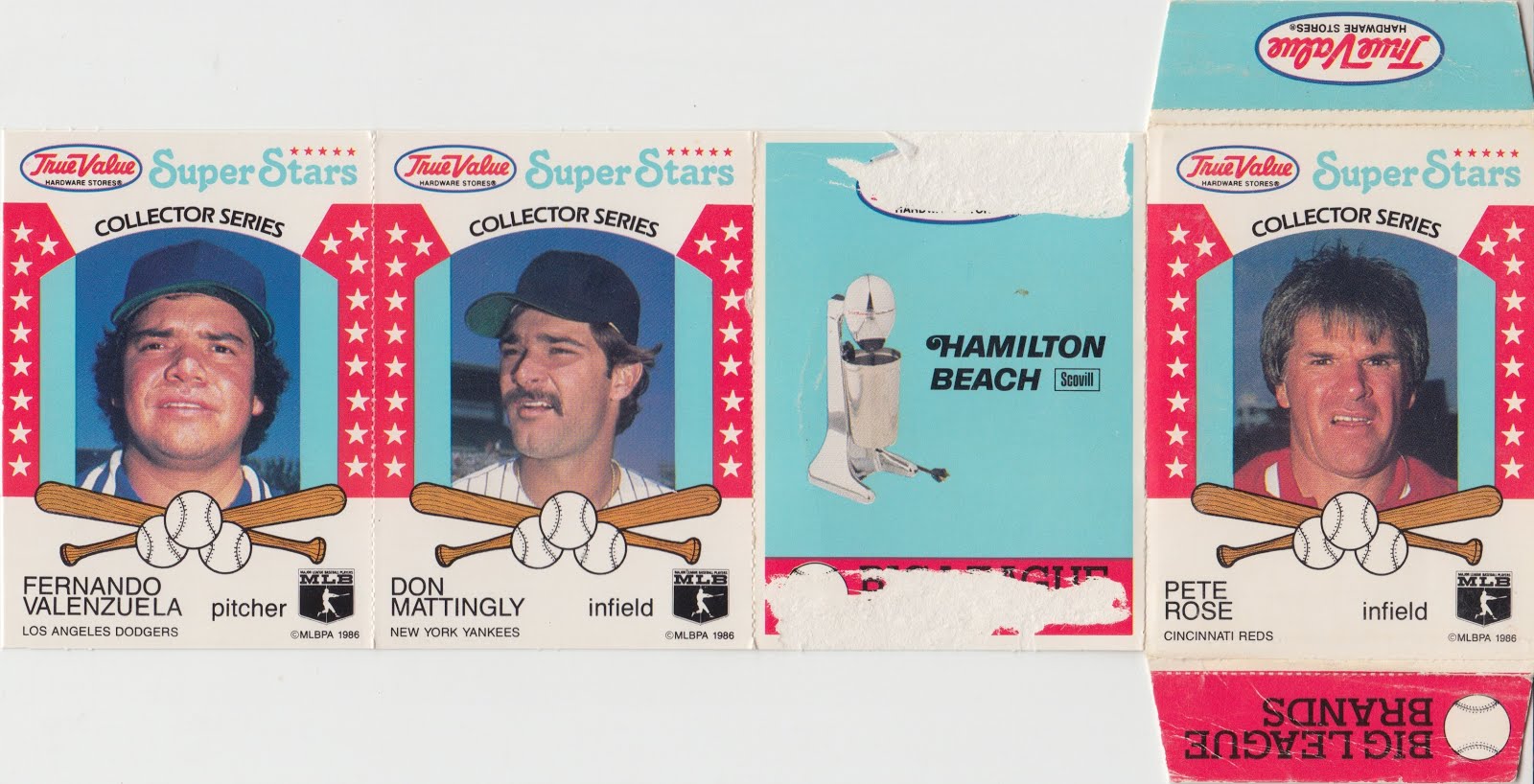
1986 True Value

INTRODUCTION TO THE SET

True Value Hardware stores as a brand grew out of a Chicago-based retailer called Cotter & Company. It is a hardware cooperative, which means that the hardware stores with the name "True Value" are independently owned businesses. Cooperatives like these band together to create a brand, to enjoy economies of scale in purchasing from wholesalers and distributors, and to engage in marketing.


Cooperatives are not franchises, and the differences between the two are stark. Cooperatives are run by their members, which create a voting structure to make decisions on important business issues facing members such as marketing expenses and promotions. On the other hand, a franchise operation is centrally controlled. Very large franchisees may have the ability to shape overall franchise decisions, but generally, the franchisor makes all decisions on what gets sold when, for how much, and how much money will get paid back to the franchisor for the effort expended in marketing.

So, True Value. While Cotter started his company in 1948 as a hardware cooperative, the True Value trademark and brand started even earlier in time in 1932. It was owned by a company called Hibbard, Spencer & Bartlett, and Cotter bought that company in 1963. Wikipedia notes that the True Value trademark was sold at a value of $2500 in that transaction.

As time passed, True Value had to grow, expand, and differentiate itself from the big-box stores that emerged as their main competition -- Home Depot and Lowe's in particular on a national scale. Thus, True Value merged with Servistar Hardware (which had previously purchased Coast to Coast Hardware) in 1997. Accounting irregularities emerged in a 1999 post-merger audit, causing a number of hardware stores to leave True Value to join other cooperatives under the names "Do It Best Hardware" and "Ace Hardware."

These days, True Value is still a viable international cooperative with stores in 60 countries around the world and 400 different locations including Jamaica, Saudi Arabia, Bolivia, Honduras, American Samoa, and Thailand.

EXEMPLARS

The cards came in panels which could be separated out into individual cards.


DETAILS

This set was issued in a total of ten panels of three cards each that included the sweepstakes card as the fourth card in the panel. According to the 2011 Standard Catalog of Baseball Cards, the cards were given out with a $5 or more purchase to customers at True Value hardware stores.


By 1986, these unlicensed Michael Schechter Associates cards seemed almost ubiquitous. I'm guessing, too, that MSA got a deal on the photos it used where it could use the same photos for each of the players as many times and in as many different sets as it desired. The same Robin Yount photo, for example, appears in multiple sets across a few years (such as the 1986 Jays Potato Chip Discs, the 1986 Dorman's Cheese set, and the 1987 Kraft Home Plate Heroes set to name 3).

Designwise, this is a car-crash set. The photos are all head shots, and the head shots are barely over a quarter of the card. The design is busy with all the stars and bats and balls and MLBPA logos and True Value logos everywhere on front and back. The stats are incomplete -- only the five most recent seasons get shown -- and even the vital information of the player's birthdate appears as a random number set just hanging out below the player's name.

The checklist itself of 30 cards is not a bad one. The stars of the day are mostly there -- Brett, Ozzie Smith, Ripken, etc. -- but there are some strange inclusions and notable omissions. For example, the Oakland A's get Dwayne Murphy, but the big name in 1986 in Oakland was, of course, Jose Canseco. The Padres are represented by Steve Garvey, but Tony Gwynn was already a certified superstar by 1986 -- twice an All-Star in the most recent two seasons and a third-place finish in the MVP voting in 1984. I'm not saying that Garvey should have been left out, necessarily, but Gwynn not being in the set is weird. Finally, the thirty cards in the set represent players from 23 of the 26 teams in MLB at the time -- the Giants, Indians, and Rangers were all left out.

HALL OF FAMERS

Fully half the set are in the Hall of Fame: Eddie Murray, Jim Rice, Ozzie Smith, Robin Yount, Tom Seaver, Reggie Jackson, Ryne Sandberg, Bruce Sutter, Gary Carter, George Brett, Cal Ripken Jr., Nolan Ryan, Mike Schmidt, Andre Dawson, and Wade Boggs


ERRORS/VARIATIONS

Trading Card Database does not list any errors or variations in the set.


However, on eBay, there appears to be a Don Mattingly variation of sorts available for a scandalously ridiculous price of $108. It might be a test print, in that it has a different number and different back entirely from the version above and the photo is cropped differently. I do not know if there are other players with this test print/variation available.

MY TAKE

This is an ugly set. Its design is terrible with all the random stars all over the place and with corporate branding taking precedence over quality baseball cards. The photos are too small, and the unlicensed nature of the cards makes all that worse.


Yet, I have strong positive memories of it.

You see, I got the panels in my collection of this set because I would accompany my grandfather to the local True Value hardware store when he went to pick up some supplies to work in his workshop on his lawn mower or his rototiller. I remember the hardwood floors in the store -- they seemed sloped in one direction or another. I remember the small sporting good section too, as I would always pick up a baseball bat and try to swing once or twice without destroying anything.

During that same year of 1986, my grandmother passed away. My grandfather was lost without her -- they had been married for over 50 years, after all -- and so he spent a fair amount of time puttering around in his workshop. He would let me help him with little things here and there -- sometimes with cutting or sanding wood, other times with cutting the lawn. But I could always tell he was trying to keep himself occupied and not thinking about his loss. That led to a lot of trips to the hardware store.

If you like this set, you can find a complete set in the panel form reasonably inexpensively on eBay. For instance, here is one that is available for $7.45 shipped. As with most of the sets from the mid-1980s, there are ample opportunities to pick up individual cards for a type-collection or player collection as well.

Saturday, July 15, 2017

1980-1983 Kellogg's 3-D Super Stars

INTRODUCTION TO THE SET

Kellogg's started as the Battle Creek Toasted Corn Flake Company in Battle Creek, Michigan, in 1906. It was an offshoot of the work that John Harvey Kellogg was doing at the Battle Creek Sanitarium, where he was superintendent. Basically, the company started because the Kellogg family were Seventh Day Adventists, a church which recommends vegetarianism and keeping kosher, and as part of that they invented Corn Flakes


The Kelloggs were trying to help develop new foods that would comply with that diet and help keep all the good people at the sanitarium on an Adventist-approved diet regimen. J.H. Kellogg believed that the best thing for the people there was a very bland diet -- no spicy or sweet foods and no alcohol, tobacco, or caffeine. These people sound like torturers to me, but your mileage may vary.


At any rate, one day, John and his younger brother Will Keith Kellogg left some cooked wheat sitting while they attended to other matters at the family business of the sanitarium. They returned too late -- the wheat had gone stale. Being cheap/on a strict budget, they tried to roll this goopy mess into doughy sheets but, instead, it broke up into flakes. The brothers toasted these flakes and served them to their patients. Apparently the patients, who must have been starved for anything with a crunch, loved them. The brothers then patented the stuff and introduced it to the world in hopes that it would reduce masturbation. No, really.


The company developed through the years and expanded its food product lines through the 1960s and 1970s. Along the way and relevant to our discussion, Kellogg's released a few sports and baseball related sets. In 1937, for example, Kellogg's had a cereal called "Pep" (a rival to Wheaties best known for sponsoring The Adventures of Superman radio series) into which it inserted a four-stamp panel of various sport stars including some baseball players (such as Tris Speaker and Walter Johnson). 


In 1948, Kellogg's Corn Flakes in Cuba issued advertising postcards in Cuban featuring perhaps 6 different Cuban baseball stars, and Pep cereal had cards issued of "celebrities" that included 5 baseball players.


In 1970, however, Kellogg's decided to get into the baseball card promotional business. Why it chose to go with the "3-D" effect cards -- or even start with baseball at all -- is not clear. A hint might be seen in the fact that, in 1969, Kellogg's acquired Salada Foods -- the same company that issued baseball coins in 1962 and 1963. Perhaps Salada saw a jump in sales and that history informed Kellogg Company. 


At any rate and as said in the 2011 Standard Catalog of Baseball Cards, "for 14 years in the 1970s and early 1980s, the Kellogg's cereal company provided Topps with virtually the only meaningful national competition in the baseball card market." The set in 1983 would mark the end of Kellogg's efforts in baseball cards until the early 1990s.


EXEMPLARS


1980


1981


1982


1983


DETAILS

During their time as a yearly card issuer, Kellogg's messed around with just about everything. They tried going without the plastic lenticular covering in 1973. They widened and narrowed the cards. They varied the sizes of the sets -- going with anywhere from 54 to 70 total cards. They even tried a 15-player "All-Time Baseball Greats" set in 1972.

Still, by the time 1980 rolled around, Kellogg's had a pretty good idea on how to issue their "3-D Super Stars" cards. The 1980 set was their 11th consecutive year with putting one card in specially marked boxes of Kellogg's products. Even so, in its last four years of issuing its 3-D Super Stars set, Kellogg's dithered around with how they distributed the cards, the size of the cards, and the size of the set. Note: all information about distribution and card size comes from the 2011 Standard Catalog.

1980's offering, for example, was available as single cards inserted into the cereal boxes and by collecting proofs of purchase and sending that with money in for redemption. The set in 1980 consisted of 60 cards (the same as 1979) but featured the narrowest format ever for Kellogg's -- just 1-7/8" wide by 3-1/4" tall.

In 1981 and for the only time in its 3-D history, Kellogg's used a standard card sized format of 2.5" x 3.5". These yellow beauties were available only by sending proofs of purchases and cash to Kellogg's -- none of them were inserted into cereal boxes. The number of cards in the set increased to 66 as well. 

The 1982 version tracked the distribution of its 1981 counterpart -- available only through sending cash and box tops to the company to get the cards. The cards shrank in size down to 2-1/8" x 3-1/4", and the set shrank to 64 cards.

Finally, in 1983, the Kellogg's set made its final appearance in and on cereal boxes as a 3-D product. The set was again narrower by a quarter inch (1-7/8" x 3-1/4") than the 1982 set, and it was four cards smaller at 60 total. It was once again available in cereal boxes as single cards and, again, as a full set. 

For 1983, I've been able to find a cereal box image online (once again from the excellent Pete Rose fansite 4192cards.com, to which full credit for the image below goes) which spells out that the set was available for $3.95 and two UPC symbols or two proof-of-purchase seals from various Kellogg's cereals (Sugar Frosted Flakes, Sugar Corn Pops, Froot Loops, Corn Flakes, or Sugar Smacks, and yes every cereal in the late 1970s and early 1980s trumpeted its high sugar content to kids):


In terms of the players included in each set, these sets are the usual effort to capture the All-Stars of the day but with some exceptions. While the 1980 set included players from each major league team, the 1981 set left out the Canadian teams -- the Blue Jays and the Expos. That's rather strange since the Expos in particular were one of baseball's top teams in the early 1980s. 

In 1982, the Expos made it back to the set thanks to Gary Carter and Tim Raines, but this time the Padres joined the Blue Jays on the sidelines. Finally, in 1983, the Blue Jays (Dave Stieb) and Padres (Garry Templeton) found their way into the set, but this time the Seattle Mariners were left out in the cold. 

Finally, any discussion about these Kellogg's cards would be incomplete without talking about the "3-D effect." If you read the fine print on the backs of these cards, you will see "Xograph®", "© [Year] Visual Panographics, Inc.", and some other legalese regarding the team logos and licensing from MLBPA. 

Xograph was Visual Panographics' trademarked manner of presenting the cards. The trademark was for "photographs having three-dimensional visual effect used as a part of postal cards, printed point-of-sale displays, printed advertisements, and printed exterior surfaces of packages and containers." A second similar trademark for the same word was for "photographic service rendered in connection with the making and furnishing to others of reproductions having a three-dimensional effect." Both of these trademarks are now dead. Visual Panographics appears to have issued one set on its own in 1975 -- one depicting the 37 presidents who had served to that point.

HALL OF FAMERS

As you would expect for an All-Star set, these four sets have a decent number of Hall of Famers in each, though, perhaps, less per capita than you might think.

1980 (20 total): Mike Schmidt, Bert Blyleven, George Brett, Bruce Sutter, Steve Carlton, Jim Palmer, Nolan Ryan, Eddie Murray, Willie Stargell, Reggie Jackson, Carl Yastrzemski, Dave Winfield, Carlton Fisk, Jim Rice, Fergie Jenkins, Ted Simmons, Tom Seaver, Phil Niekro, Johnny Bench, Rod Carew

1981 (23 total): Palmer, Jackson, Schmidt, Ryan, Brett, Rice, Stargell, Niekro, Tony Perez, Murray, Winfield, Joe Morgan, Carew, Rickey Henderson, Seaver, Rich Gossage, Yastrzemski, Carlton, Alan Trammell, Paul Molitor, Sutter, Robin Yount, Bench

1982 (24 total): Brett, Henderson, Jack Morris, Ozzie Smith, Rollie Fingers, Seaver, Ryan, Winfield, Jackson, Schmidt, Sutter, Don Sutton, Gary Carter, Fisk, Carlton, Yount, Bench, Gossage, Niekro, Palmer, Yastrzemski, Carew, Tim Raines, Murray

1983 (21 total): Carew, Fingers, Jackson, Brett, Henderson, Yastrzemski, Gossage, Murray, Rice, Yount, Winfield, Harold Baines, O. Smith, Ryan, Morris, Sutter, Palmer, Carlton, Carter, Fisk, Schmidt

Edit: added Hall of Famers inducted since original post. 

ERRORS/VARIATIONS

If you know anything about the Kellogg's sets of the 1970s, you know that they were riddled with statistical and copy errors in the written information on the backs of the cards. 

Not so with these four sets. None of them have any corrected errors or variations according to Trading Card Database: 1980, 1981, 1983.

-EDIT-

As reader Dancfuller and his Carlton Fisk blog noted, there is, in fact, an uncorrected error in the 1982 Kellogg's set: Carlton Fisk is listed as having played in 1981 for the "Chicago NL" team rather than the AL team. Thanks for that catch!

MY TAKE

Like most collectors over the age of about 40 or so, I have always had a soft spot in my heart for these cards that was accompanied by a bit of sadness. The sadness comes from how poorly many of these cards have held up over the years thanks to that plastic lenticular layer that the Xograph process seemed to require. The plastic causes the cards to curl -- like these four sets shown in an eBay auction:


Also, the plastic layer often cracks without anything causing it to crack -- probably due at least in part to the desire of the cards to curl up. I've borrowed this image from Night Owl's post in 2015 titled, "Get to Know Me: Kellogg's Cards":


As Night Owl said in his post, cracked Kellogg's cards make me sad too. I will also echo what Night Owl said about these 1980s cards: while the cards from the 1980s in my opinion are pretty nice, Kellogg's cards are a 1970s phenomenon. 

While I was barely a collector in the late 1970s -- I was as much of a collector as a kid aged 6 to 8 could be -- I still had the 1978 and 1979 sets in my collection thanks to my mom sending off for them for me. I guess I wasn't paying close enough attention in 1980 or 1981 (or we didn't have the spare money available to buy the cereal necessary to get the cards) because those sets were entirely new to me when I returned to collecting in 2014. By 1982, though, I was in full accumulation mode. That meant that I insisted on getting the 1982 and 1983 sets for my collection.

I think what makes these cards beautiful in many respects is the fact that all of them are posed photos that highlight the player. The quality of photography is good as well. It's a jarring juxtaposition to put one of these cards from the early 1980s next to a random 2016 Topps flagship card -- the smiling face of Richie Zisk next to a random pitcher/hitter in action grimace....which one looks better to you?

Due to their wide availability, Kellogg's cards from the early 1980s are easily found on eBay whether in sets or in individual cards. A few interesting highlights I have found:

1.  One seller is asking $110 for all four of these sets together. I think you can do better by buying them individually with just a little bit of effort, though.

2. This seller has an intriguing find: an uncut sheet of the 1981 set for $29.99 shipped. If uncut sheets were not a bit difficult to store/display, I'd be tempted.

3. "Zartanthegreat1" would like $25 to send you a three-card proof panel of Kent Hrbek, Bob Horner, and Gary Carter from the 1983 set. 

Just don't ask Zartan to send you any Super Sugar Crisp cereal.

Thursday, July 13, 2017

1980 Topps Burger King Pitch, Hit & Run

INTRODUCTION TO THE SET

First off, please note that this post will not cover any of the Burger King team sets, nor will it cover the 1986 and 1987 sets that Burger King issued called "All-Pro." This set is a one-off -- a one-year only oddball from Topps and Burger King.

Burger King was started in Jacksonville, Florida, in 1953 under the name "Insta-Burger King." It literally was meant to rip off the McDonald brothers' concept -- the founders Keith Kramer and his wife's uncle Matthew Burns had visited the first McDonald's in San Bernardino, California, and liked it so much that they bought their "Insta-Broiler." This broiler -- the famous "flame broiler" of Burger King fame -- became required equipment for the stores.

Kramer and Burns franchised the concept to some franchisees, including a group in Miami led by James McLamore and David Edgerton. When the original company failed in 1959, these two gentlemen purchased the company, restructured it, and renamed it Burger King. Even today, when you fly into Miami International Airport, you can see BK's corporate headquarters just across the Dolphin Expressway off NW 57th Avenue. 

Pillsbury Company bought BK in 1967. Its efforts toward restructuring led to hiring former McDonald's executive Donald Smith to revamp the company to franchise the concept properly, to increase menu choice, and standardize restaurant designs. When Smith left (for PepsiCo in 1980), Norman Brinker took over. Between Smith and Brinker, BK challenged McDonald's for burger supremacy. But, when Brinker left for Chili's, the company struggled again. 

Since then (and I won't bore you with more corporate history), BK has gone through multiple owners and concepts. Most recently, BK performed a reverse merger with Canadian coffee giant/restaurant Tim Hortons so as to move its nominal headquarters to Canada and receive tax benefits as a result.

Full disclosure: my father-in-law works for a very large BK franchisee. Further disclosure: BK's food is much much better than McDonald's, except for French fries. Nothing beats McDonald's French fries.

One more item to know: what Pitch, Hit, & Run is: PHR was a part of MLB's Official Youth Program to get kids between ages 8-13 playing baseball. Kids were tested on their skills, and winners went to a national event. 

Here's an ad from 1979 for it. Note that this advertisement puts the ages at 9-12:


And here is a store sign that I found in a Google Image Search:


Note that the store display comes from 4192cards.com, a Pete Rose super collector site. Full credit goes to them for this photo.

EXEMPLARS

While they look like 1980s Topps, you can see the red backs here. 1980 Topps had blue backs. These images are from Trading Card Database and its checklist.


DETAILS

Burger King issued these in packs of three plus an unnumbered checklist with every purchase of a large order of fries. A total of 34 cards were issued -- thirty-three different players and that checklist. 

The card design mimics the Topps base set for 1980s but with a couple of key differences. First, as you can see, the Burger King logo features prominently here. It is in the corner where the player's position was otherwise located. Second, we have the addition of the "Collector's Series" title next to the player's name -- again, in the same location as where the player's position was. Third, we have those red backs. For reference, here's the base 1980 Topps:


Perhaps most interestingly of all, though, is the fact that Topps did not pull the trick it uses regularly these days in reproducing the same photo on the same design in 800 places. A number of the photos are different. For instance, here are the Vida Blues from each:


I went through the set, and the photos in this Burger King set fall into four categories. First, some photos are exactly the same as the Topps base set. Second, some photos between the flagship and the BK sets are the same, but the BK set is cropped differently (some only slightly). Third, some players have entirely different photos -- like the Vida Blue above. Finally, four players are shown in entirely new uniforms in the Burger King set. Here's the checklist, broken down that way:

Same: Steve Carlton, Don Baylor, George Brett, Bill North, Willie Wilson

Cropped Differently: Rollie Fingers, Phil Niekro, J.R. Richard, Bruce Sutter, Rod Carew, George Foster, Dave Parker, Jim Rice, Pete Rose, Enos Cabell, Cesar Cedeno, Julio Cruz, Frank Taveras

Same Team, Different Photo: Vida Blue, Ron Guidry, Jerry Koosman, Jim Palmer, Tom Seaver, Keith Hernandez, Reggie Jackson, Fred Lynn, Dave Winfield, Dave Lopes, Omar Moreno

Completely Different Team: Nolan Ryan, Bobby Bonds, Ron LeFlore, Joe Morgan

I do not have a good explanation for these changes (other than the team changes, of course). Those that were cropped differently for Burger King almost invariably improve as baseball cards -- as if someone said, "you're right, we shouldn't have cut off his feet in the photo." A lot of the different photos turned action shots to portraits. There's no real rhyme or reason to it.

How Topps and Burger King put this set together is a bit of a mystery. I mean, I feel like there were Burger Kings in Wisconsin in 1980, but there aren't any Brewers in the set. Only 19 of the 26 teams in existence at that time got cards; the Brewers, Tigers, White Sox, Blue Jays, Indians, Rangers, and A's did not get any cards in the set. The Astros got 5 (with the addition of both Nolan Ryan and Joe Morgan from other teams). Why Frank Taveras and Bill North? Why one Cub and zero White Sox? 

HALL OF FAMERS

Out of the 33 players in this set, just thirteen of the players are in the Hall of Fame -- a rather disappointing number for what ostensibly is an All-Star set. They include:

Carlton, Fingers, Niekro, Palmer, Ryan, Seaver, Sutter, Brett, Carew, Jackson, Rice, Winfield, Morgan

ERRORS/VARIATIONS

The Trading Card Database does not list any errors or variations.

MY TAKE

I feel like these were not in Wisconsin in 1980. I think that for a couple of reasons. First, there are not any Brewers in the set. Second, I don't have any of these cards. I turned 8 just before the end of 1979, and my baseball-card collecting was in full swing in 1980. I put together nearly the entire 1980 Topps flagship set, but I have no recollection of ever seeing these. I feel certain that if I had known of their existence, I would have been clamoring to visit Burger King to buy fries.

Then again, I don't know that a Burger King was open anywhere near where I lived. And perhaps that is the simple explanation for how the set was put together. Places where there were Burger Kings got players, and places without them did not. It's a reasonable guess.

For the most part, the changes in photography really make this set better looking than the base set. Even the cropping changes are better other than, perhaps, the Rollie Fingers. It's an attractive set with a number of good players despite the random inclusion of just okay players like Enos Cabell. Still, though -- Frank Taveras? He was coming off a year in which he hit .263/.301/.337 with 42 steals in 61 attempts. I mean, I guess Topps/BK remembered him leading the NL in steals in 1977?

For what it is worth, the Pitch Hit & Run competition lives on today. As of 2017, it is sponsored by Scotts Company (the turf people). The local competitions have already taken place, as have the sectional competitions. The finals just finished up during All-Star Week. As the PHR website notes, Eric Hosmer, Chris Parmelee, Matt Wisler, Brewer Michael Reed, and former Blue Jay/current Lotte Giant Andy Burns are all PHR alums. The "Hall of Fame" on that site lists former National Finalists after the competition's restart in 1997 who were drafted.

Your eBay purchasing options for this one are very limited. There are a decent number of singles available, but there is only one complete set, and the seller is looking to get $25.98 for it (shipping included). There is also the "ultra-completist" set -- thirty-three unopened cellophane packs of the cards, each containing a different card on the front of each pack -- that you can buy from "buygreatinvestmints" for $156.99. Perhaps the one that makes me laugh hardest in some respects is this checklist. It's graded Gem Mint 10 and all, but it makes me laugh derisively that the seller wants $80.99 for it (shipped). It makes me laugh even harder that his/her original price was $135.99! 

Monday, July 10, 2017

1984 Donruss Champions

The Shlabotnik Report asked if I take requests and asked if I would feature the "one-and-done 1984 Donruss Champions set." Your wish is my command!

INTRODUCTION TO THE SET

In 1983 and in a set that will eventually feature here, Donruss tried something that one would have expected TCMA or one of the other underdog/lesser lights of card production to have done: Donruss put out a 44-card set called "Hall of Fame Heroes" featuring art from Diamond King artist Dick Perez and consisting entirely of Hall of Fame members. While Topps had included Hall of Famers in various subsets within its flagship set (such as the "All-Time" team in 1976 Topps and the season-and-career leaders in the 1979 set), it had not paid much -- if any -- attention to baseball history. Once a player retired from playing, they would only show up again in a set if they became a manager.

Now, I am guessing that either Donruss had a contract with Mr. Perez that allowed them to lean on him for more artwork or that the company liked the Hall of Fame concept but wanted to pair it with current players. Why they chose to do it with an oversized card is not clear. Still, at least Donruss was trying different things to use its license to create different sets to get collectors' attention.

Apparently the venture either was not successful or proved too difficult to execute for more than one season, since the product was shelved after one year in production. 

EXEMPLARS

The big thing with this set is that it combined Dick Perez's art for the Hall of Famers with normal photography for the active players in the set. 


DETAILS

The set composition here is noteworthy for the mixing of Hall of Famers and active players. Certainly, the 1982 Topps K-Mart 20th Anniversary set highlighting 20 years of MVPs did the same thing, but the conceit behind this Donruss set was more unusual. As the last card of the set -- the Checklist card -- fills us in:


Some of the selections of "Grand Champions" were either questionable or could have been any number of people, while others were simple. 

The Questionable: 
  • The Grand Champion for Season Home Runs was Babe Ruth (rather than Roger Maris...Ford Frick strikes again). 
  • The Grand Champion for Season Batting Average was Ted Williams -- the last to hit over .400 -- rather than Hugh Duffy (.440 in 1894) or, if you're inclined to say modern baseball began with the American League in 1901, Nap Lajoie at .427 in 1901.
  • For Career Batting Average, Donruss used Rogers Hornsby in its effort not to have two Ty Cobb cards.
  • For the World Series, Mickey Mantle. For me, Yogi Berra should have appeared instead. 
  • For All-Stars, Carl Hubbell, whose inclusion was based entirely on his striking out Babe Ruth, Lou Gehrig, Jimmie Foxx, Al Simmons, and Joe Cronin in succession in 1934. That 50th anniversary must have mattered a lot. In light of the fact that all the players selected were hitters here, I would have selected Willie Mays or Stan Musial, both of whom are tied with Hank Aaron for most All-Star games at 24 (and benefited from a time in the early 1960s when 2 games a year were played)

The Simple: 
  • Hank Aaron for Career Home Runs
  • Ty Cobb for Career Hits (I guess he is here because of Pete Rose's chase being topical in 1984)
  • Cy Young for Career Wins
  • Walter Johnson for Career Strikeouts (though Steve Carlton had passed him in 1983, Carlton was still active)
  • Frank Robinson for MVP (as the one player to date who has won the MVP in both leagues)

The cards measure 3.5" x 5" -- the same as the Donruss Action All-Stars of the day. Due to ties -- such as the log jam at 41 HRs in a season -- the number of players for each category seems almost random. Also, it would have been a more straightforward set to use ERA, stolen bases, and maybe saves rather than using MVP, World Series and All-Star. 

As you can see from the card backs for Ben Oglivie and Jeff Burroughs, Donruss used a stat called HR% -- simply home runs as a percentage of at bats -- for the home run hitters. I'm pretty sure that Donruss used the "All Star" category just to add in three players -- Steve Garvey, Dave Parker, and Gary Carter -- that they felt like adding into the set. The fourth All Star highlighted Fred Lynn's grand slam homer (off Atlee Hammaker).

In retail, the cards came packaged similarly to how its similarly sized product Donruss Action All-Stars did in 1984: 5 cards to a pack in cellophane wrapping and three pieces of that ubiquitous Duke Snider puzzle.


HALL OF FAMERS

There are a whole bunch of Hall of Famers in this set. You start with the Grand Champions, all of whom are in the Hall, and you go from there. It's a total of 36 out of 60 cards that feature Hall members:

Grand Champions:  Babe Ruth, Hank Aaron, Ted Williams, Rogers Hornsby, Ty Cobb, Cy Young, Walter Johnson, Frank Robinson, Mickey Mantle, Carl Hubbell

Active Players: Jim Rice, Reggie Jackson, Carl Yastrzemski, Mike Schmidt, George Brett, Wade Boggs, Eddie Murray, Rod Carew, Tony Perez, Gaylord Perry, Fergie Jenkins, Phil Niekro, Jim Palmer, Steve Carlton, Nolan Ryan, Tom Seaver, Don Sutton, Bert Blyleven, Joe Morgan, Rollie Fingers, Robin Yount, Cal Ripken Jr., Johnny Bench, Carlton Fisk, Paul Molitor, Gary Carter

ERRORS/VARIATIONS

The Trading Card Database does not show any variations or error cards.

MY TAKE

When you read the rather perfunctory history of Donruss available on Wikipedia, it notes that Donruss had problems with "overproduction and distribution" early on in its life as a card manufacturer, and that its merger into Leaf, Inc., helped benefit Donruss through using Leaf's established distribution network. Maybe so, but I can say that I don't think I ever saw these cards in the wild growing up as a kid. 

In fact, I don't know that I ever saw any of these cards until they started showing up either on eBay or in trades from people when I got back into collecting in 2014. I like these cards as a player collector, of course, because it's always nice to get "your guys" in a set -- and for me, four of my "guys" in Robin Yount, Paul Molitor, Ben Oglivie, and Cecil Cooper made it into this set. Indeed, this is a very strange set to me as Brewers fan and collector -- fully 10% of the set is comprised of Milwaukee Brewers when you add in Rollie Fingers and Don Sutton.

I am not a big fan of the photography in this set. While many people sing the praises of 1980s Donruss, the company consistently had problems with photographic quality. Photos are dark (like the Brett above) or the printing process threw in too much red, which tended to make black players appear purple and white players look like they were severely sunburned -- like Jeff Burroughs.

If you look on eBay to see your purchasing options for these cards, you will find a fair number are available and with prices all over the board. A complete set goes for $8.39 shipped. A few empty sales boxes are available as well; I should probably pick one up since Robin Yount is featured on it. The cheapest unopened box with 36 packs in it is for sale right now for $18.64. Or, if you're feeling sporty, you could grab this 7-box lot of four Action All-Stars boxes, a Champions box, and a 1987 All-Stars box for just $69.99 shipped. For the oversized card lover, that's almost a bargain.

Saturday, July 8, 2017

1982 Zellers Montreal Expos

INTRODUCTION TO THE SET
Zellers was a Canadian discount retail outlet similar to Walmart and Target. It was founded in 1931 by Walter P. Zeller as "stores for thrifty Canadians." By the mid-1970s through a variety of corporate acquisitions and working agreements, Zellers had expanded from fourteen stores in Southern Ontario to a chain of 155 stores by 1976. 

That led other Canadian retailers to get interested in Zellers once its American friend, W.T. Grant, had to withdraw from Canada. After discussions about selling a controlling interest to Fields, a Vancouver clothing retailer, Zellers instead flipped the transaction and purchased Fields and Marshall Wells (the hardware stores owned by Fields). Incidentally, Fields is a different company entirely from the midwestern department store Marshall Fields.

By 1978, Zellers offered to purchase one of the oldest companies in North America, the Hudson's Bay Company. Once again, when the sale was consummated, the purchase was flipped and Zellers was purchased by HBC. HBC completed its purchase of all outstanding shares in Zellers in 1981 and issued the cards that are the subject of this post in 1982.

Since 1982, Zellers has nearly disappeared from the Canadian marketplace. As happened in the United States, retailers of Zellers' ilk struggled in the face of cutthroat competition from Walmart. By the end of 2010, HBC (which had been purchased by a South Carolina businessman) decided to stop the bleeding and started selling leases to Target Canada. Zellers liquidated its inventory in the stores slated to change to Target and, for some, Walmart. 

If you know about how this worked out, then you know that Target Canada shut up shop by early 2015 due in part to the locations they purchased and in part to terrible supply-chain processes that often left stores full of empty shelves. As Slate noted, the problem was that the Canadian stores had no way to order inventory properly from distribution centers. Whatever showed up each day showed up, and company rules precluded filling empty shelves with on-hand inventory. 

Nonetheless, Zellers continues on today in Canada in just two Ontario locations (one in Etobicoke and one in Nepean) as a liquidator for HBC and, to an extent, Home Outfitters. There are some calls -- limited though they may be -- to bring back Zellers to the old Target locations, but those attempts seem quixotic.

EXEMPLARS


DETAILS

In its efforts to capitalize on a very successful 1981 in which the Montreal Expos made their singular appearance in the playoffs (defeating the defending World Champion Phillies in the NL East Divisional Series 3-2 before losing to the eventual World Champion Dodgers in the NL Championship Series 3-2 thanks to a 9th inning home run by Rick Monday), Zellers issued a 20-panel set of baseball tips featuring 12 of the stars of the 1981 team.

The panels measure 7.5" by 3.5". Each panel is separated by a perforation that allows the three-card panel to be separated into individual cards -- as is the case with the Gary Carter autographed card above that comes from my collection. As one would expect for a Canadian set, the cards feature titles on the fronts and tips on the back of the card that are both in English and in French.

The cards do not carry any statistics at all. I assume that these cards are fully licensed in some fashion to allow Zellers to use player names and likenesses and to use team colors and logos. Of course, the set does not include the team name anywhere, so perhaps they just made the set and hoped they wouldn't get sued.

As I mentioned above, there are 20 panels but only 12 different players are featured. Here's the short version of the checklist:

Gary Carter: Panels 1, 6, 13, 16, and 19
Steve Rogers: Panel 2
Tim Raines: Panel 3
Andre Dawson: Panels 4, 10, and 14
Terry Francona: Panels 5 and 11
Warren Cromartie: Panels 7 and 18
Chris Speier: Panel 8
Billy DeMars (third-base coach for the 1982 team): Panel 9
Woodie Fryman: Panel 12
Bill Gullickson: Panel 15
Scott Sanderson: Panel 17
Ray Burris: Panel 20

HALL OF FAMERS

Thanks to the multiple panels for Gary Carter and Andre Dawson along with the single panel for Tim Raines, this set is almost half Hall of Famers.

If Terry Francona is voted into the Hall of Fame as a manager -- which has a fairly decent possibility of happening thanks to his success with the Boston Red Sox (744 total victories, second in club history, a .574 winning percent, and two World Series Championships) and with Cleveland (a World Series appearance and a .544 winning percentage as of this writing) -- then fully 55% of this set will feature Hall of Famers.

ERRORS/VARIATIONS

For whatever reason, the Trading Card Database shows Warren Cromartie Panel 7 in its list of errors and variations. I cannot discern a reason for that listing. His name is spelled right, it's clearly Cromartie on the panel, and I do not see any errors in the copy on the back of the card. Anyone know why this is the case?

MY TAKE

As a kid, I was a catcher. In the early 1980s, there was no better catcher in the major leagues than Gary Carter to me. Johnny Bench was in full decline mode and near retirement, and Carlton Fisk was an irascible soul whose slow work behind the plate was the bane of every baseball fan's existence for making every game a 3-hour-plus death march. Carter was a smiling, laughing, happy guy who enjoyed playing the game. Easy call there to like Carter.

So, I became a Gary Carter collector. Part of being a Carter collector to me was sending him close to 20 cards through the mail for signature at various times. I never sent more than five or six at a time, and I always made sure I put proper postage to get the cards back, of course. But, I'm pretty sure I failed to put Canadian postage on the envelopes. This meant that Carter or someone at Carter's direction must have carted the mail back across the border on several occasions to make sure that I got my cards back to me. That's when I got the Zellers Carter card above autographed -- some time in the early-to-mid 1980s.

The 2011 Standard Catalog of Baseball Cards notes that this set is not terribly popular with collectors despite the fact that the set contains a number of major stars. The big book notes that "collectors do not generally like the playing tips idea." I suppose that is true. I cannot think of all that many sets that feature playing tips on the cards, so my range of discussion on this is limited.

If you like this set and want to put it together, you are in luck. It appears that the set is reasonably available today on eBay either in single card or panel form. There are several sellers who have the uncut set available on eBay, with prices ranging from $8.74 to $48 shipped. The best deal for an oddball collector might be to pick it up with the 1988 Hostess Canadian discs, the 1986 Provigo, and the 1987 Blue Jays police card set for $16.95 with free shipping.

In fact, that's very, very tempting....